





Antique Brass
London
Brass is what we do at depth: real metal, multiple shades, the finish matched to the taps and controls already in your room. Made to your measurements, in the UK.

We make every brass shower screen, door and enclosure to your room. And we hold several brass tones, not one stock colour — so on any shower, with or without a frame, we match the metal closely to the taps, controls and fittings you already have. No off-the-shelf kits — every one a bespoke shower built around your room.
Call 0333 090 8736
Monday-Friday 7.30AM-4PM
Brass and gold are almost the same finish — so close that brass shower glass is often sold simply as gold. The colour is in the metal parts: the hinges, handles, brackets and frames that hold the glass. It comes in several tones, and in polished, brushed (satin) or antique textures, each lacquered or unlacquered.
A brass walk-in shower screen, a folding panel or a gold bath shower screen — the form varies. Across these shower screens the brass shows in the wall brackets, hinges, support profiles or perimeter frame, matched to the taps, shower head and controls already in the room.
A brass shower door moves, so it skips the fixed brackets and channels a screen needs. Its brass is in the hinges it swings on — always there on a door, where a screen only has them when it folds — and in the knob, handle or grab rail you push and pull. A brass perimeter frame can wrap these glass shower doors too, or they go without.
A brass shower enclosure combines a door with one or more fixed panels — a door and a screen in one — so it carries the brass of both, plus a perimeter frame around the whole thing if you want one. That makes these glass shower enclosures the layout with the most brass on show.
Three brass surface finishes — polished and brushed worked mechanically with abrasives, antique aged with chemicals. Same brass underneath — different optical effect. This is the surface decision, before any question of protection or material. The gallery shows installed brass from across our catalogue; the text breaks down what each finish actually is.
A finish — polished, brushed or antique — is only the surface look. It's a separate choice from the metal underneath (solid brass or anodised aluminium) and from whether it's lacquered, both covered next. So any of the three works in either metal, lacquered or not.
A mirror-like shine that bounces the light straight back — the sparkle that makes it read as gold, since gold catches the light the same way. It's brass at its brassiest — the boldest pick for a polished brass shower door or a gold shower screen.
A soft matte texture, brushed into fine lines. Unlike polished, it doesn't bounce the light back — it stays calm, and hides water spots and fingerprints better. Often called satin or brushed gold, it's the favourite where polished feels too bright.
Darker, deeper-tone look. Two ways there: artificial chemical treatment (factory-aged, fine darker lines) or natural ageing on unlacquered material (ombre, irregular, more characterful). Both suit an antique brass shower door, screen or enclosure — how to choose is covered next.
Our standard frame finish. The same aluminium profiles behind every brass framed shower screen, door and enclosure, dipped in a brass-tone anodising bath so the colour penetrates the metal evenly. Polished and brushed brass tones only. Antique can't be replicated this way — that path needs real brass material, covered next.
Which you choose follows the rest of the bathroom — the taps, shower head and controls our brass has to match. Most of those aren't solid brass; they're usually stainless or other metals finished to a brass tone, then sealed to keep it looking new. Lacquered matches that, and is the default; unlacquered is the deliberate choice for real metal that ages.
Most brass projects are lacquered — a matter of matching, not preference. Brass-finish taps and controls are usually stainless steel underneath (rigid enough for the slim shapes soft brass can't hold), given a brass tone and sealed under a clear lacquer that holds it unchanged for years. Lacquer isn't a finish of its own — polished, brushed or antique, it simply seals the look you chose. We seal our brass to match: simpler, cheaper, and what most clients ask for.
Less common, but a deliberate choice. Some clients want solid brass throughout — taps, controls and shower head, with our brass matched to them — installed without lacquer so the whole bathroom patinates naturally over years. Air, water, soap and skin oils all contribute; the install darkens evenly from bright yellow towards deeper antique tones. For those who want the antique look without waiting, we artificially pre-patinate the brass before installation — like buying mature trees instead of saplings.
Unlacquered brass behaves differently from a sealed finish — it reacts and ages over time. Three simple things worth knowing before you choose it.
Antimicrobial
Brass is mostly copper, and copper kills germs on contact — it's why hospitals still use brass handles. But this only works on bare, unlacquered brass; lacquer seals the surface and switches the effect off. For that benefit on the handles you touch daily, choose unlacquered.
Why we leave frames bare
Lacquer keeps brass looking new, but if it chips, that spot darkens while the rest stays bright — leaving patchy marks that never even out. So we leave brass frames unlacquered on purpose: the whole frame ages slowly and evenly, in step with your unlacquered taps and shower head.
Brass and marble
Unlacquered brass slowly turns slightly green as it ages — harmless on its own. But brass cleaners are acidic, and if they run onto nearby marble they can leave a greenish tint in the stone. Easy fix: keep a small gap where brass meets marble and wipe up spills. We flag it at survey when a design puts the two together.
Anywhere a brass shower needs a full frame perimeter — doors, screens or enclosures — the frame profile takes one of two material paths. Anodised aluminium is the sensible default for most framed installs. Real brass material is reserved for cases where it's the only thing that will work — antique brass frames being the main one.
A brass frame turns the shower into a design feature — a warm-metal perimeter visible from across the bathroom, almost always paired with brass taps and controls so the whole room reads as one finish. Both paths below give a similar visible look. The differences sit under the surface — how the finish behaves over time, and what it costs.

Around a third of the cost of the same frame in real brass, and far lighter. The anodising process fills tiny pores in the aluminium with brass-toned dye — the colour goes into the metal, not on top, so it won't chip or scratch off. Polished or brushed only; antique can't be done this way. It stays consistent for the life of the install — no patina, no tarnish, just easy cleaning.
Antique is patina, which is irregular by definition — anodising can't replicate it. When the project calls for antique brass on the frame profile, we CNC bespoke real-brass profiles. Brass is three times heavier than aluminium and roughly three times the price per kilo, so the two factors compound to about ten times the raw material cost. Installed unlacquered so it ages alongside the bathroom's taps and controls, slowly deepening towards dark bronze.
Caledora sources frameless brass hardware from premium EU and US suppliers. Multiple brass shades available across hinges, knobs, U-channels and towel rails — from the brightest gold and ultra-light brass through to several deeper antique variations — so each project gets a brass tone matching the bathroom's existing finishes.

Shades across our brass range
From a brushed brass shower door to a gold shower enclosure, we pick the closest shade to your existing taps, controls, mirror frames and towel rails — so the whole bathroom reads as one finish. Several frameless shades plus two framed paths (anodised aluminium and real brass) give us the range to fine-tune to the room. Ready-made antique hinges carry a lacquered, artificial finish that shifts a little batch to batch, so on multi-shower projects we order them together.
Brass reads as gold, and gold looks its best against light, clean surroundings — white tile, pale marble, bright plaster — where the warm metal becomes the focal point rather than competing with a busy backdrop. The glass you pair with it matters just as much: the right glass lets the brass tone read true, while the wrong one can cast a faint shadow over it. Here is how the two main options compare, and which one we fit as standard.
Clear glass — our default. Standard on every shower, and the choice for most projects: a clean, classic look that suits any bathroom. Float glass carries a slight green cast — most visible at the polished edges, and as a soft greenish tint on pure-white surfaces seen through the panel: a bright ceiling, white marble. In most rooms it goes unnoticed, and it keeps the project cost down.
Ultra-clear — an optional upgrade. Low-iron glass has the green removed at the manufacturing stage, so it's almost completely colourless. White stays white through it — the ceiling, the marble behind the panel — and brass reads as the gold it is meant to be, undimmed by any green wash. The upgrade we recommend whenever brass is chosen as the room's high-end, "gold-like" finish.
Whatever you choose, it's easy-clean. Clear, ultra-clear, frosted, tinted or fluted and reeded glass — the glass is your decision, and every option pairs with brass. Whichever you pick, the inside face gets an easy-clean coating as standard: a treatment that helps water and limescale slide off, so the glass stays clearer for longer with far less scrubbing around the brass fittings.
Brass in the bathroom doesn't have to mean gold-finished metal parts in shower glass too. Across our work we often pair brass taps, head and rails with shower hardware in black or bronze. Sometimes the brass set was chosen for the bathroom before the enclosure was added; sometimes the room calls for stronger contrast, or a deeper, more characterful palette. The brass fittings lead, and the shower's metalwork is free to differ.
The fittings lead. We start every design from the brass already chosen — the taps, controls, shower head, towel rail — and match our hinges, handles and frame profile to them. From there the frame's finish is the free variable. Brass on brass is the obvious pairing, but when clients pick something else, the same two finishes come up far more than the rest: bronze and black.
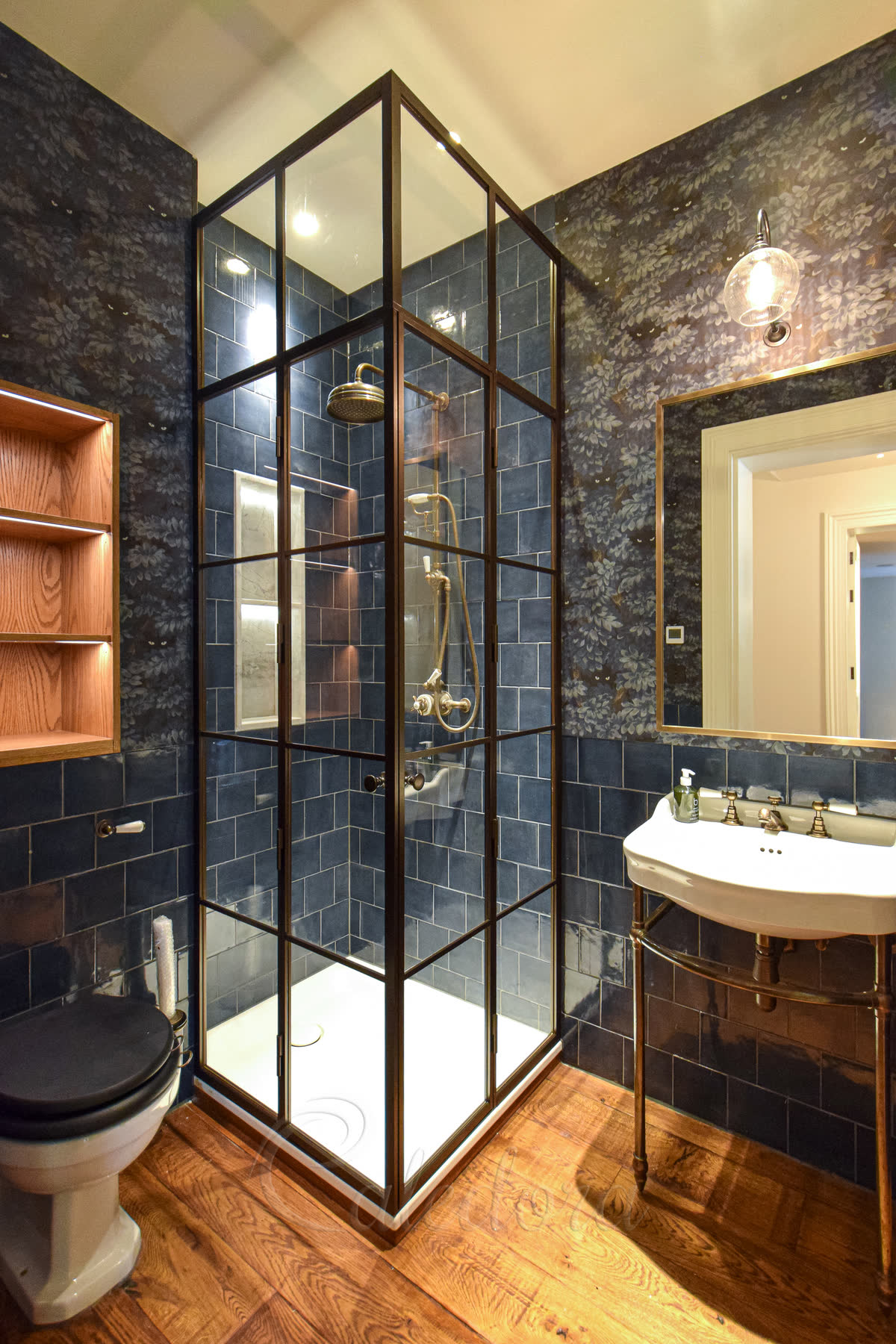
Antique brass and bronze are close cousins on the warm-metal spectrum — brass sitting at the brighter end, bronze at the deeper. Together, as in this London corner where a dark bronze grid frame surrounds antique brass taps and head, the eye doesn't separate the two: the whole shower reads as one quietly aged metal, the deep end of the warm-metal range.
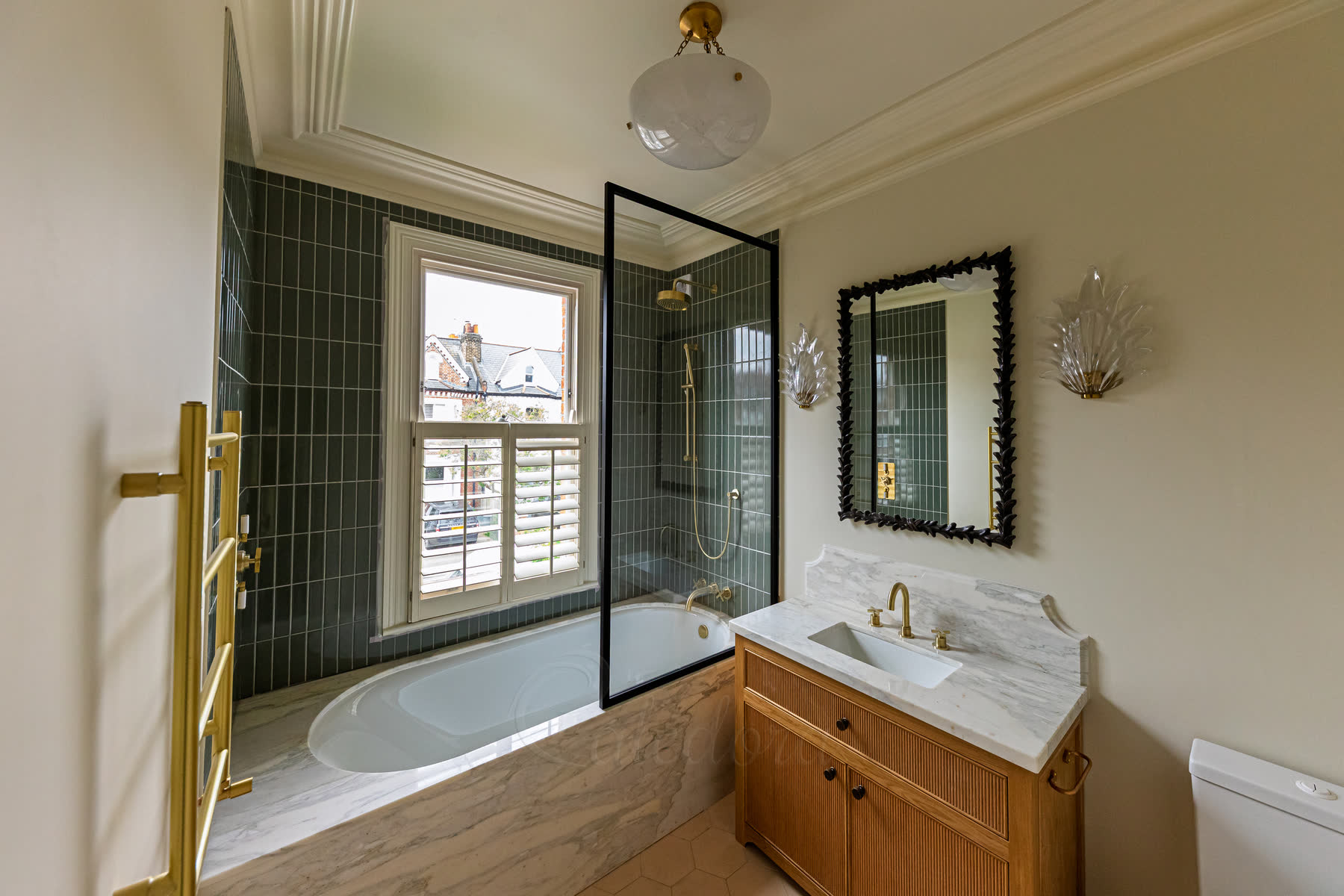
Black does the opposite — it pushes brass forward by contrast. This London bath screen sets brushed brass throughout — towel radiator, controls, shower head, handset and vanity tap — against a plain black frame. The brass glows where it sits, framed by black, exactly the high-contrast effect you'll find across our black shower screens.
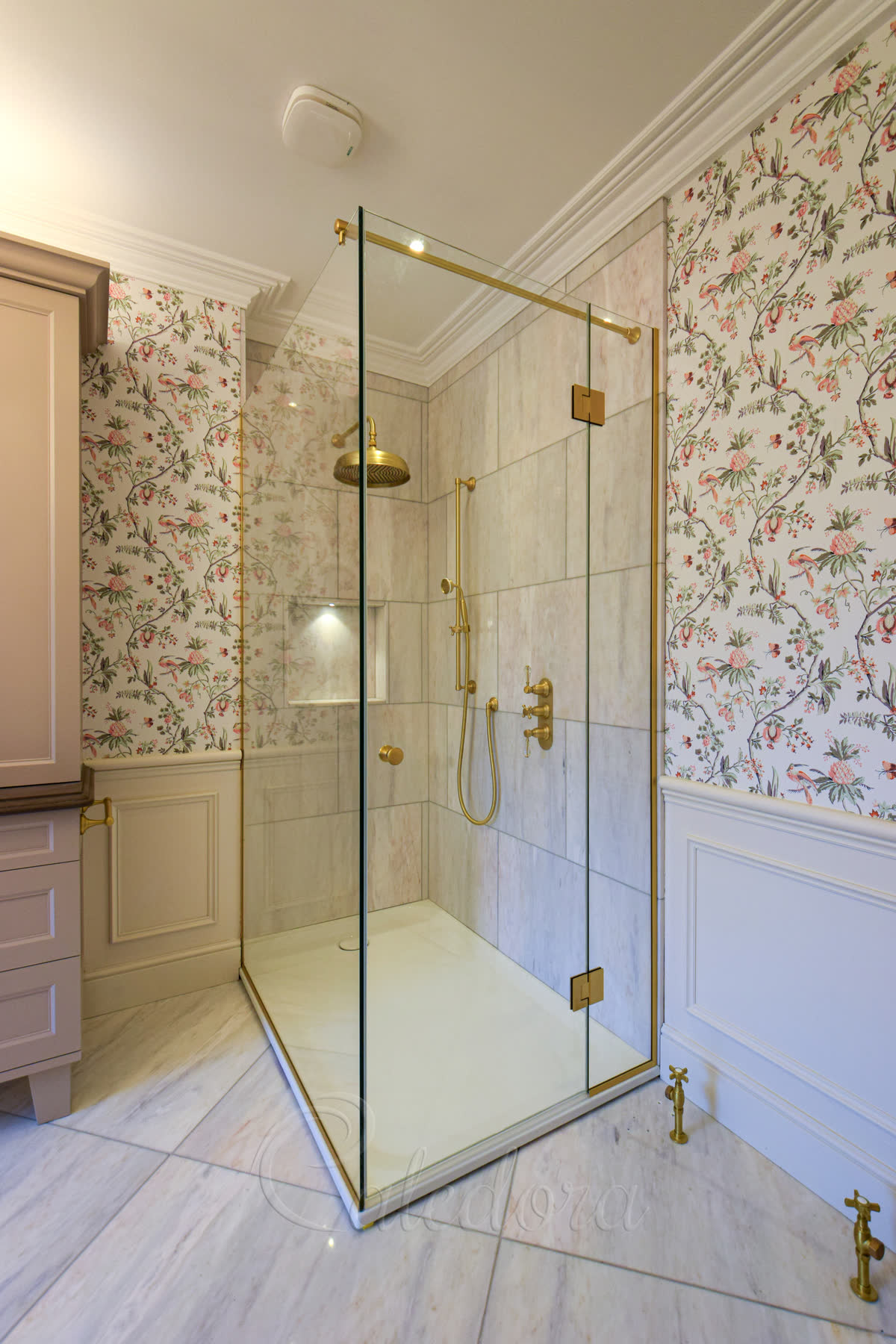
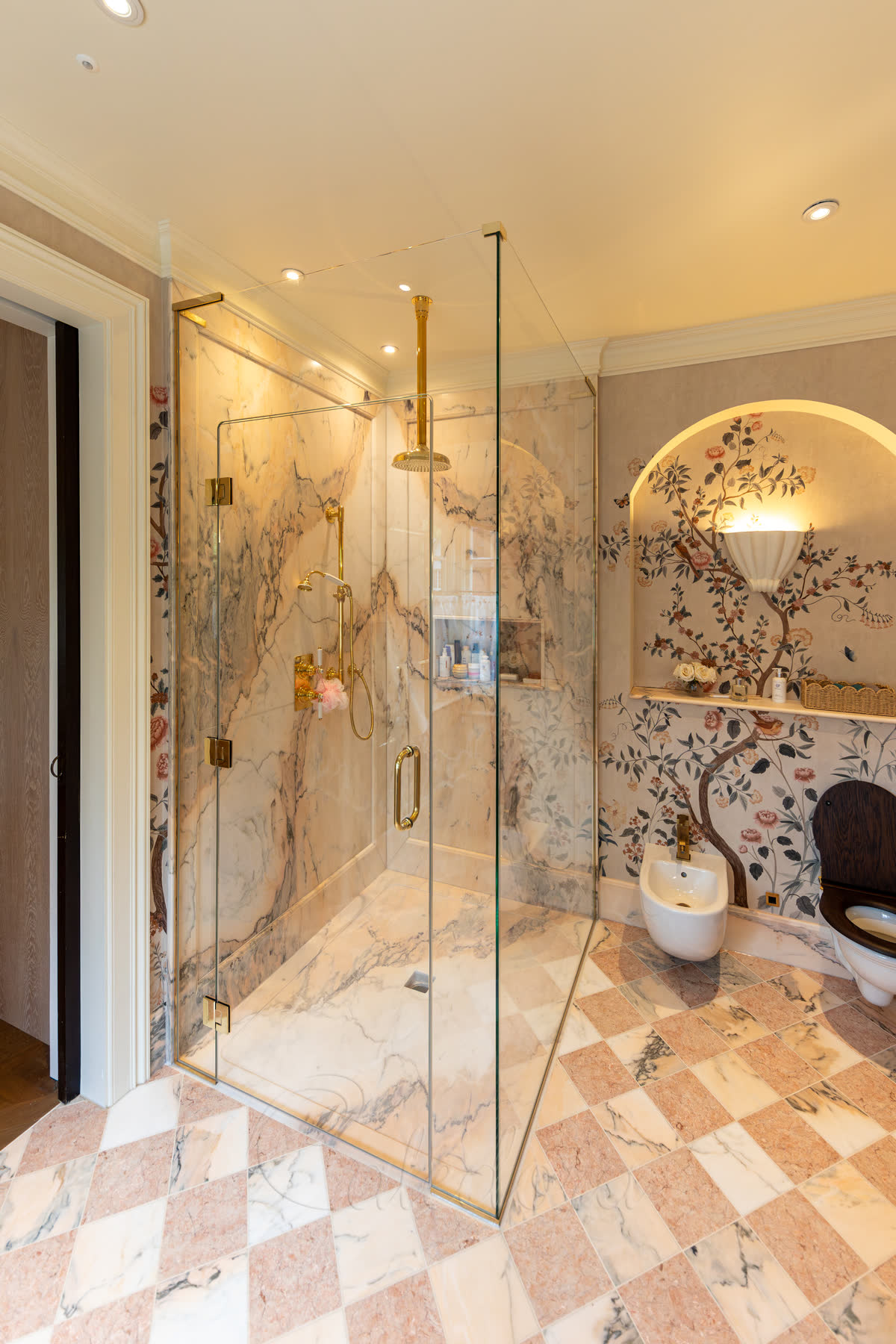
A spread of polished, brushed, antique and gold brass across doors, screens and enclosures — every one designed, made and fitted by Caledora.


A handful of brass showers we have designed and fitted — polished, brushed and antique, across doors, screens and enclosures. Each one made for a specific bathroom; click through for full photos, hardware specs and notes.


Tell us what you have in mind — the room, the existing taps and fittings, the brass or gold tone you are after. We will match the finish and quote the full package: survey, design, manufacture and installation.
Mon–Fri 7:30 AM – 4:00 PM · Most quotes returned within 2–3 working hours
The same colour can be a lacquered hinge, an anodised frame or a real-brass frame at about three times the cost, so there is no single price, and the number of items and above all the travel move it too. Our bands come from real jobs: one item, fitted within about an hour of our Milton Keynes or London base, survey, design, making and fitting all included, VAT not included, guidance only — £ up to £1,700, ££ £1,701–£2,800, £££ £2,801–£3,600, ££££ £3,601–£9,000 and £££££ over £9,000. Our frameless brass mostly sits in £ to £££, antique jobs from ££ up, and framed brass doors sit in ££££. Each project page carries its band, and can be filtered by it.
It depends on the route. Standard (lacquered) polished or brushed brass frameless hinges cost roughly the same as chrome or black; lacquered antique adds a little, and unlacquered fixtures cost more. On framed installs, anodised brass aluminium is the affordable choice and what most projects use, while frames cut from solid brass material — needed for a true antique look — cost considerably more.
Almost the same. In 99% of cases the two words are used interchangeably, and we treat them as one warm finish across the bathroom. Side by side, though, there is a real difference: gold is the brighter of the two — more reflective, with a cleaner, more vivid yellow — while brass sits a touch deeper and more subdued, a softer, earthier warmth that can carry the faintest hint of brown or green. On our frameless hinges both exist as distinct lacquered shades, so you can pick whichever suits your taps — though they are unmistakably from the same gold-yellow family.
Yes — though what we build is properly called a gold shower enclosure. A cubicle usually means a ready-made pod sold complete with its own tray, walls and sometimes a roof; ours is the opposite — glass panels and a door cut to your measurements, with the gold or brass hardware matched to the rest of the room. If a squarish corner cubicle is the look you're after, a corner enclosure does exactly that, without the plastic.
That's exactly what we aim for. We carry several brass shades on the frameless hardware — from bright gold and ultra-light brass through to deeper antique tones — plus two framed paths (anodised aluminium and real brass). At the survey we compare samples against your taps, controls and towel rails and pick the closest match, so the shower reads as part of the same scheme rather than a near-miss. For an exact match — when budget allows and the stock shades aren't quite right — we can also artificially age real brass to a specific tone, a bespoke route at extra charge.
It changes — and how it changes is the interesting part. Speed and pattern depend on the room's humidity, the water and soap it sees, and what touches it. A handle gripped daily darkens faster than a hinge on a fixed panel; the side facing the shower spray ages differently from the side facing the room. The result is an individual patina rather than uniform tarnish — and many clients pick unlacquered specifically for that character. If you'd rather it stayed bright, lacquered is the fixed-finish alternative.
Yes. For real-brass material we can accelerate the patina so it arrives already aged, rather than waiting months for it to develop naturally. On the frameless hardware, several suppliers offer their own antique brass finishes ready-made. If your project spans more than one shower, we order the antique pieces in a single batch so the tone matches across them.
Day-to-day, no — soapy water and a soft cloth covers most installs. Lacquered or anodised brass stays best with soap and water or a mild glass cleaner; avoid anything abrasive, which would damage either finish. Unlacquered brass that's developing a patina is the same: gentle products only, so the patina is left intact. To reset unlacquered back to bright bare brass — say if the design changes and you want it new again — Brasso (a gently abrasive metal polish) takes the patina off in seconds. It's a deliberate reset, not routine cleaning, since each use wears the metal very slightly. Full routines for every finish and glass type are in our shower glass care guide.