


Antique Brass
Leicester
Choose the right door mechanism

No Swing Space
Glass shower doors keep water inside your shower while providing easy access. Choose sliding, hinged, or bifold doors based on your bathroom space and needs. Our doors use 10mm toughened glass with an easy-clean coating, and we help you pick the best door mechanism for your shower.
Different door mechanisms work better for different bathrooms. Sliding doors save space, hinged doors give full access, and bifold doors work best in tight areas. Your choice depends on the bathroom layout and how much room you have. The same mechanisms hang the doors of our glass shower enclosures — every enclosure is built around its door.
Sliding shower doors use track systems and need no swing space. Perfect for small bathrooms where hinged doors would hit toilets or vanity units.
Standard hinged shower doors open both ways with full access. Glass doors swing in and out with elastic seals to keep water inside.
Bifold doors fold panels together for a compact opening. Perfect for smaller shower trays with obstacles like toilets in front of the shower door.
Each door type works differently for your bathroom space and needs. Hinged doors give full access but need swing room. Sliding doors save space but need wide shower trays. Bifold doors work best in small bathrooms. And when the layout drains well without a door at all, a fixed walk-in shower screen skips the mechanism entirely.
Most shower doors are 650-750 mm wide for best performance. Larger doors need more space to swing open and are harder to reach. You may need to step back to open expansive glass doors.

SIZE-LARGE
We can make hinged doors up to 1000 mm wide, but they cost more and are harder to use. Wide doors are needed for wheelchair access, which requires around 900 mm opening width.
It's best to split wide openings into a fixed glass panel plus a standard door. If obstacles prevent the door swing, use bifold doors, which need less space. Use sliding doors if your shower tray is wide enough.
Many clients call standard hinge doors "pivot doors," but real ones work differently. True pivot doors spin around their ceiling- and floor-fixed hinge centres. Standard hinged shower doors seal better and last longer than pivot systems.
Pivot doors cause sealing problems and poor operation. We do not recommend them for shower installations.
Pivot doors need pins fixed to your shower floor, which creates seal problems. The bottom hinge sits at floor level and cannot stop water effectively. These hinges have gaps near the floor that let water escape.
Pivot doors only attach at the top and bottom with no middle support. This makes them wobble and feel flimsy. The small plate holding the hinge moves over time and becomes difficult to seal properly.
We install a fixed glass panel to the pivot point, then add standard hinges for a smaller door. This provides you with better sealing at floor level with full-width seals and the same opening size.
We can install pivot doors, but we strongly advise against them for showers. Standard hinged shower doors work much better – they swing both ways without the problems that pivot doors cause.
We make any glass type you need, all with easy-clean coating that stops soap and limescale buildup. Our frameless shower doors use 10mm-thick toughened glass as standard. We offer different finishes to match your bathroom design and safety needs.

We only use toughened glass in our shower doors, which we can also laminate for design or extra safety. While everyone talks about safety benefits, the real reason is practical – non-toughened glass cannot handle the stress of door hinges and would crack. Toughening makes glass 5 times stronger, so it can last for years.
We can supply any glass type, but some work better with certain door types. Laminated glass needs protected edges and works best with framed doors. Frameless hinges cannot grip fluted glass shower doors properly — the vertical ribs stop the gasket seating — so we frame these decorative options instead.
Our shower doors come in many finishes, shapes and designs. We work with different handle suppliers and can make custom options on our CNC machine. We advise on handle types and positioning, but we often work through architects or companies, so we don't meet the final user. Since everyone has different heights, please consider what works best for you; however, for individuals between 170 and 180 cm tall, these are the optimal positions.

50mm polished hole for finger grip in glass doors or sliding doors. Good height: around 1100 mm from floor level.

Most knobs stick out 30 mm from the glass, so they work best on wall-mounted doors. Good height: around 900 mm from floor level as you place your thumb at the top.

Handles give the most comfortable grip, but they hit the walls on wall-mounted doors. Good centre height: around 1100 mm, or keep your wrist level with the floor.

A towel rail on the outside and a knob on the inside can be handy. You can reach your towel by opening the door into the shower. Good height: around 950 mm.
For raised shower trays, place handles halfway between the tray and the bathroom floor levels. This provides comfortable access from both sides. You must decide on handle placement before we start production, as we cannot adjust it after installation.
Chrome is the default finish on every door we hang — and the one most rooms ask for. But when the bathroom's metalwork makes a statement, the door can follow it: matt black for definition, brass and gold for warmth. Both families have dedicated pages, with bronze to follow — and on any of them, the door hardware is matched at survey to the taps and fittings you already own.
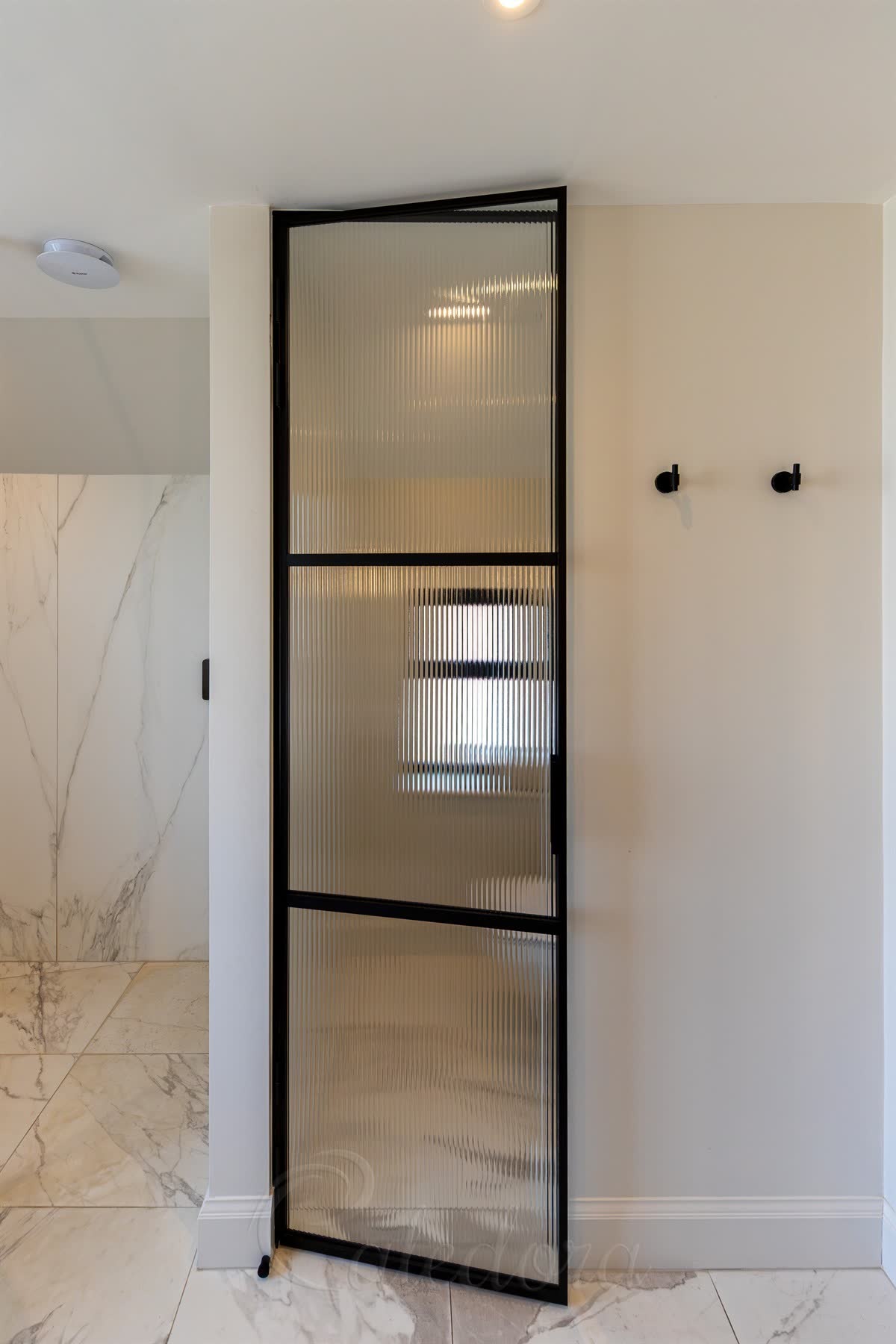
Matt black hinges, handles and frames define the door against pale rooms — anything from a single hinged panel like the reeded door pictured to a full industrial-style grid. Black is our most popular statement finish, and the whole family — framed, sliding and hinged alike — lives on our black shower doors page along with finish technologies and design guidance.
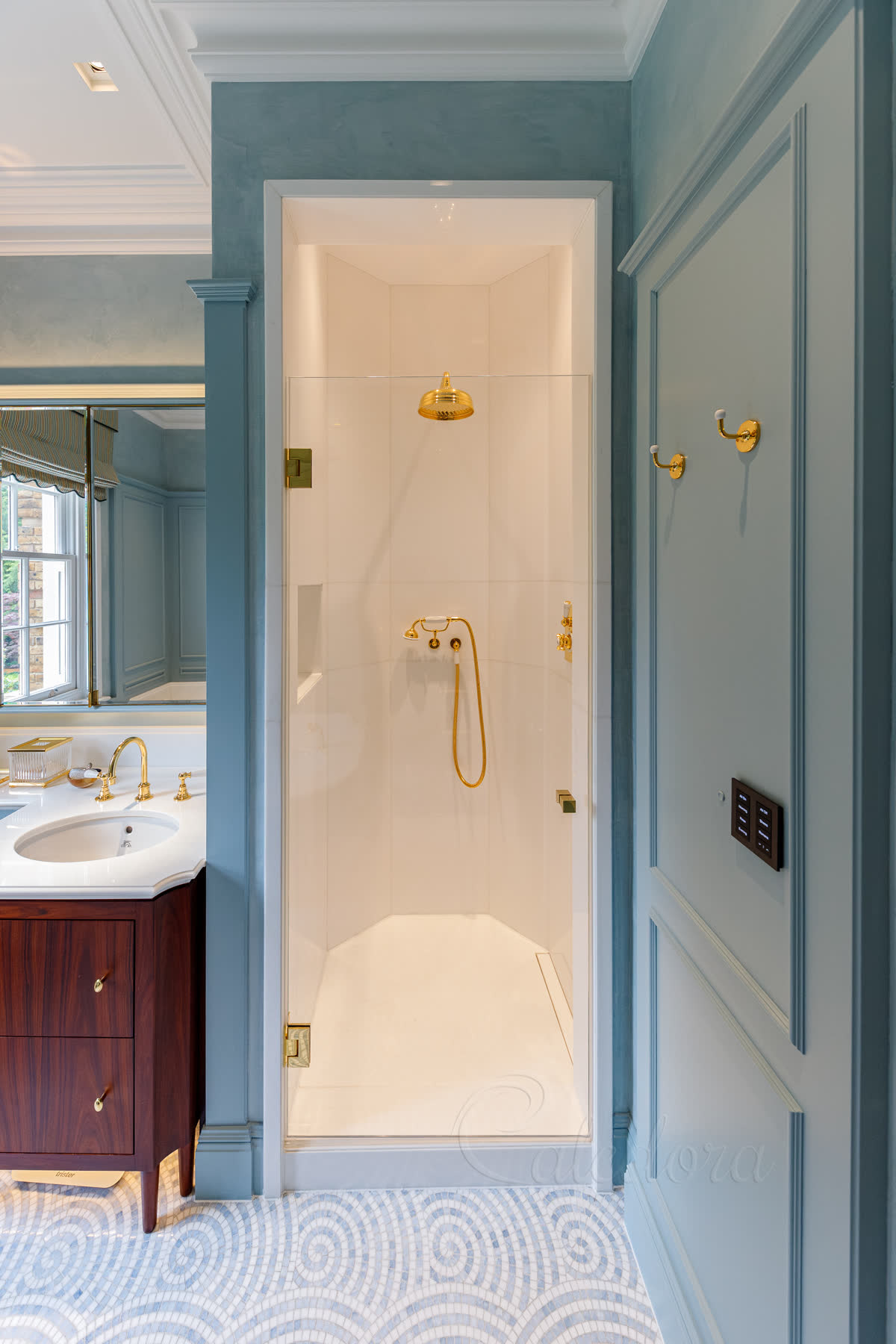
The warm route — brushed brass is the favourite, with bright gold and aged antique close behind, lacquered or left to patina. Hinges, knobs and frames all carry the finish, matched at survey to your taps — as on the alcove door pictured, its polished brass hinges answering the shower set inside. Whether it is a brushed brass shower door or a full gold enclosure, the brass and gold page covers every shade we hold.
Hinges, seals and floor thresholds control water in shower doors. The hinge type is most important – it dictates if seals can run continuously or have gaps. Floor thresholds provide the final barrier to prevent water from escaping at floor level.
Shower door seals are flexible PVC strips that attach around the door edges. They stop water from escaping by pressing against surfaces. You can replace them when they turn yellowish and stiff from soap and water. They usually last 6-36 months, depending on drying conditions.

The door swings both ways because the hinge pin sits in the centre of the glass. This breaks the seal where the hinge is located. The hinge has small gaps, so direct water pressure may cause some water to escape. Normal showering doesn't cause problems.
Doors slide past fixed panels with a 50 mm overlap that stops water, depending on where your showerhead points. Bottom guides prevent seals at the floor, so we use higher thresholds instead. You can avoid some seals with two fixed panels or use one side seal when touching a wall.
Panels fold in one direction because hinge pins sit outside the glass. This lets panels fold together with continuous seals that never break. We drill the glass and attach hinges from one side, preventing water pressure problems.
Frames have small hinges built into one side that open one way, like bifold doors. Hinges don't block the seal path. Seals are built into the frame edge and stay continuous. Frames give excellent water sealing. We compare framed and frameless shower doors in full on their own page.
Floor thresholds are essential barriers that stop water from escaping under shower doors. Without thresholds, bottom seals press against uneven floors, take the form of high points, and eventually wear out or lose flexibility.

Water builds up on the floor, and a seal alone cannot hold it back. Water finds small paths through grout lines or gaps where the seal doesn't press perfectly. Without a threshold, the door seal must press into the uneven floor and take the shape of the high spots. Eventually, the seal wears out or gets stiff and starts letting water escape.
We install thresholds that lift the door about 10 mm above the bathroom floor. This keeps both the bottom seal and threshold working together to keep water in. You can place a mat in front of swing doors since the door sits higher. Our clear acrylic thresholds look like glass, are barely noticeable, and feel comfortable to step on with rounded edges.
We create all types of shower doors - sliding, hinged, and bifold systems with toughened glass. Our custom door mechanisms work with any bathroom space from compact installations to luxury wet rooms.


4.9 / 5
On Google, Houzz & Trustpilot — from real installs, never paid
10,000+ items fitted
Residential & trade — UK-wide since 2014

Official member
3-year warranty
On workmanship — every install
£5m insured
Public + Products Liability · £10m Employers' — never claimed
A selection of shower-door installs we feel best match this page. Sliding, hinged and bifold mechanisms in every finish — click through for full photos, hardware specs and project notes.


Every shower door we make is built to order at our Milton Keynes workshop — sized, hinged and finished to your bathroom rather than a catalogue. Our bespoke shower doors service includes a 3D site survey, design visualisation, UK manufacturing, and professional installation by our permanent fitters.

Bespoke shower doors for:
UK-based manufacturing gives full control over every detail — frame profile, hinge geometry, threshold height, seal layout. Catalogue products cannot match this level of customisation.
Read what our customers say about their shower door installations. From design consultation to final installation, we deliver exceptional service and quality work.
Get professional help choosing the right door mechanism, glass options, and custom sizing for your bathroom. Our expert team guides you through the entire process from design to installation.
Monday-Friday 7:30AM-4PM
Yes — our frameless hinged shower doors swing both inward and outward by default. The hinge pin sits in the centre of the glass, so the door rotates equally in either direction. This is useful when space is tight on one side: if a toilet or vanity blocks outward swing, you can open the door inward for entry. Framed doors and bifold doors swing one direction only — usually outward (which we recommend for safety), though inward is also possible if the layout calls for it.
Bifold doors are the most space-saving — the panel folds in half when opening, needing about half the door's width in clearance. On trays around 800mm with a toilet or vanity directly in front of the shower opening, bifold is often the only viable mechanism; hinged doors need full clearance for outward swing, and sliding doors need a tray nearly double the door width to work well. Bifold panels fold flat against themselves, leaving a clear entry. If space isn't the constraint, hinged remains the cheapest and most familiar option.
Our seals last significantly longer than standard. Industry-standard clip-on PVC seals are 20mm U-channels that slot onto the glass edge — water gets trapped behind where they clip on, dirt and soap build up, and the seals yellow and stiffen within 3–6 months. We designed our own minimalist seals instead: 7–8mm, bonded to the glass edge with water-resistant adhesive tape rather than clipped on. With no channel to trap water behind them, our vertical seals age much more slowly — we've seen installations where they still looked like new after 4+ years, though results depend on use and ventilation. Bottom seals still wear faster because they sit in constant water, and we offer a replacement service or DIY seal kits when the time comes. Mild cleaners protect the seal adhesive too — the safe routine is in our .
No — and the distinction matters. A hinged door has side-fixed hinges, usually two or three attached to a wall or another glass panel. A true pivot door has just two fixings: one pin in the floor and one in the ceiling, with the door rotating around the central axis. Many clients call their hinged doors 'pivot' in conversation, but we'd advise against specifying a real pivot door for a shower — pivot doors leak at the bottom fixing, wobble without middle support, and offer no practical advantage over a side-hinged door.
A small amount of water can sometimes reach the floor under a frameless hinged door because the bottom PVC seal loses flexibility over months of use — it stiffens and stops pressing evenly against the floor. That's why we always install a threshold: a 10mm acrylic bar bonded to the tray or wet-room floor, creating a dedicated barrier under the door. Without a threshold, the warranty doesn't cover bottom leaks — the seal alone won't last. Replacing the PVC seal restores sealing when the threshold alone isn't enough.
Usually yes, though it depends on the tray's condition and the dimensions available. The first step is a survey at your property, where we measure the opening accurately and check that the tray perimeter is sound enough to take the fixings and sealant. If the tray is damaged, warped, or too small for a workable door layout, we'll discuss alternatives — including fitting a new tray alongside the glass. Retrofit installations are common; the usual restriction is space (not enough clearance in front of the opening for a hinged door) or tray condition, not the tray itself.