




Brushed Nickel
London
Three mounting styles. Self-aligning frameless hinged shower doors.

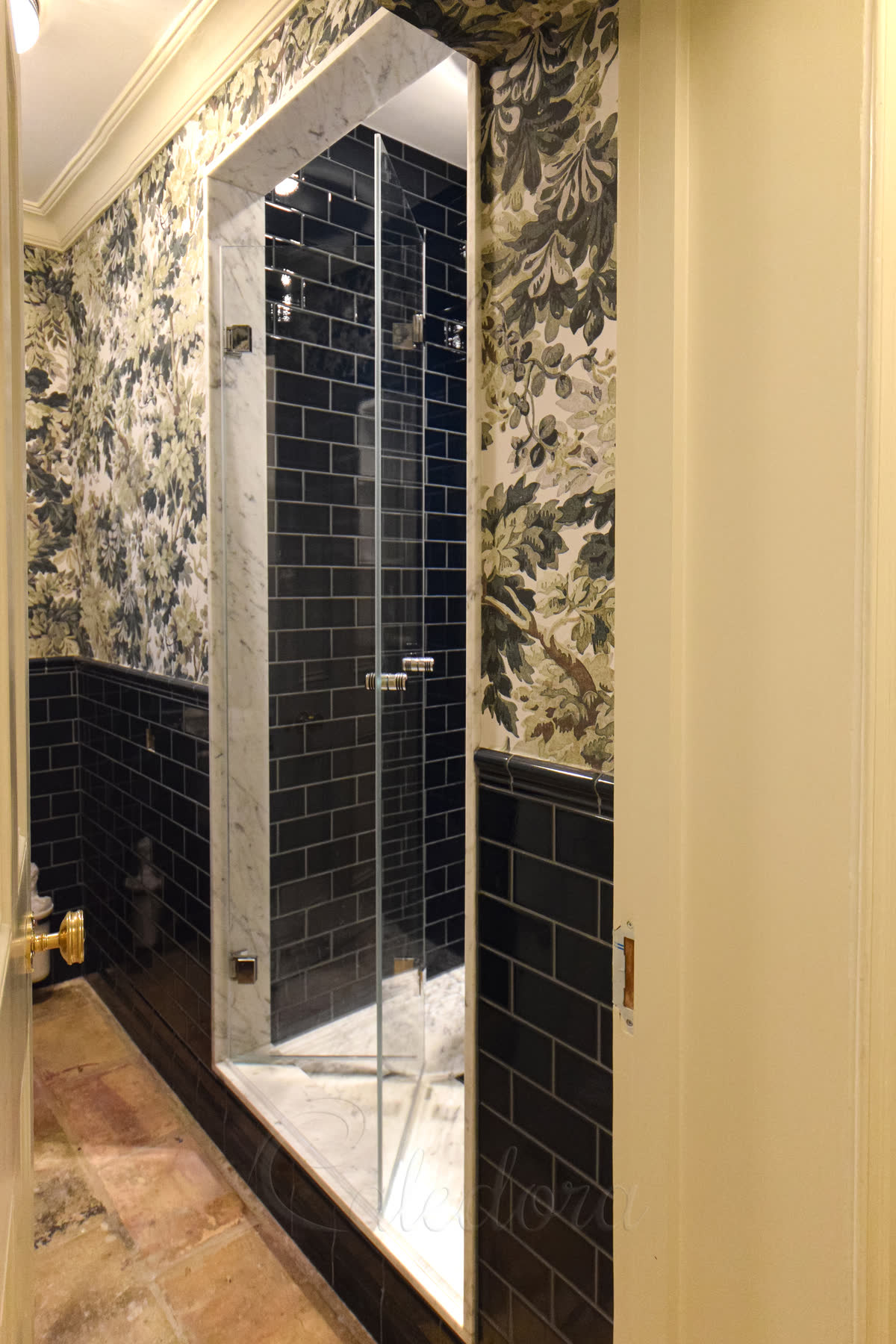
Glass-to-Wall · Nickel
Double-Door · 10mm Ultra ClearGlass-to-Glass
Hinge from panelFramed
180° · aluminiumFrameless hinged shower doors swing 90° each way, with hinges that self-align the final 15° to close cleanly. Glass-to-wall is the standard mount; glass-to-glass works across various enclosure layouts. 24+ metal finishes plus minimalist seals on the glass edge. Framed available when you need one-way swing or reeded/laminated glass — or see the full shower door range for other mechanisms.
Call 0333 090 8736
Monday-Friday 7.30AM-4PM
A hinged shower door is a single glass panel mounted on side hinges that swings on a vertical axis — the same principle as a bathroom door. Frameless models swing 90° in either direction; framed models swing up to 180° in one. The hinges fix to a flat reinforced wall, or to a fixed glass panel beside the door. With no track, no rollers, and no folding mechanism, hinged is the simplest of the three main shower door types — almost always the cheapest, and available in the widest range of finishes.
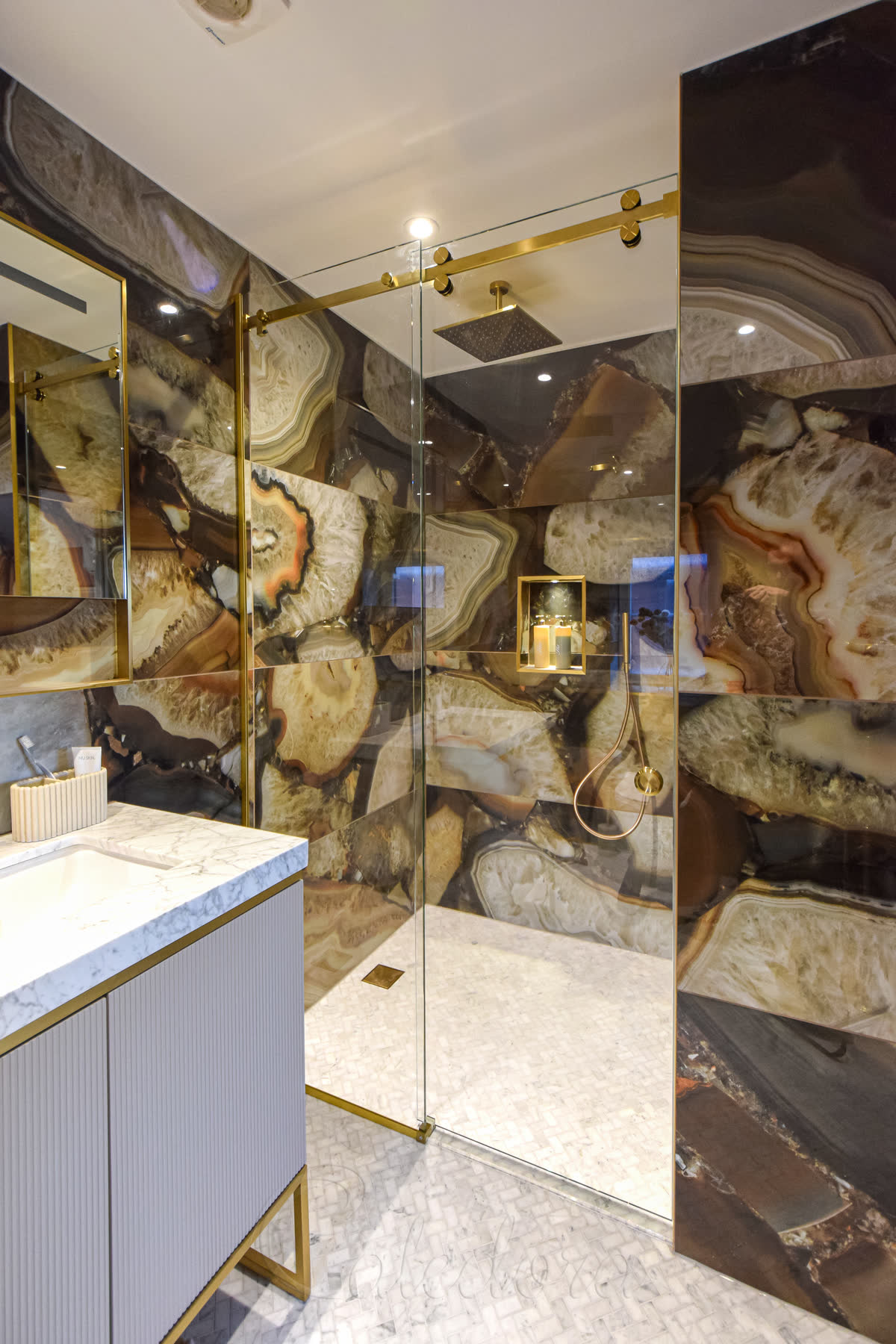
Frameless · Brass
Hinged accounts for around 90% of the shower doors we install. In practice that usually means: one glass panel, two hinges, perimeter seals, and a handle or knob — the entire spec fits on one line. If you're not sure which mechanism to pick, hinged is almost always the right starting point.
Available in 24+ standard finishes combining base metals (brass, copper, bronze, gold, chrome, black, nickel) with treatments (polished, brushed, satin, antique) — an antique brass shower door is as standard an order as a chrome one. Not every metal × treatment pairing is stock — some are bespoke. For any shade outside the standard range we offer bespoke colour-matching: PVD coating on frameless hinges, anodising on framed hinge profiles. Compatible with clear, ultra-clear (low-iron), bronze tinted, sandblasted frosted, and toughened laminated glass. Reeded and fluted glass are framed-only.
Hinged works in most bathrooms. But when space is unusually tight, the opening is unusually wide, or fixtures sit in the swing arc, one of the other two door mechanisms is the simpler starting point. Here's what each alternative does better than hinged — in three points each.
When you picture a frameless hinged shower door, you probably imagine a single panel of glass hinged off a tiled or marble wall above the tray. A single panel needs something solid to hinge from — usually the wall, sometimes a fixed glass panel beside it. Wall-mounted is the standard configuration: the simplest that exists, and the cheapest to specify if your wall supports it.
Frameless · Glass-to-wall
The frameless hinge for a wall-mounted door fixes to the wall with screws anchored into reinforced backing behind the tile. The hinge bolts through 8mm or 10mm toughened glass via a notched edge — single-door widths typically run 600-700mm, going up to about 1000mm with three hinges or heavier-duty hardware. The door swings 90° both inward and outward, stopping at 90° each way against a hard stop — frameless hinges are dual-direction by default.
On wall-mounted doors we usually advise a knob over a handle. A knob protrudes less, so the door opens fully against the wall instead of stopping short — and our chrome knobs carry a rubber insert to prevent metal-on-tile impact. The dual-swing capability has one small consequence: the side seal breaks at each hinge mount where the body needs to clear the swing arc both ways.
Minimalist
Caledora's standard 8mm PVC perimeter seal sits directly on the glass edge — no clip-on hardware, no internal cavities for water to collect in. The minimalist look in the picture is partly because of this: nothing breaks the line of glass except the hinge itself. Outlasts standard clip-on alternatives by years.
The off-set plate is a metal rectangle that bolts to the hinge body and screws into the wall — it's separate from the clamping part of the hinge that grips the glass. How the plate's screws are arranged determines what's visible from inside and outside the shower. Three configurations exist; we default to the one that keeps the exterior cleanest.

Caledora default
Three screws on the inside face of the plate, anchored into the reinforced wall behind the tile. Screw heads face into the shower — visible only from inside the enclosure. From the bathroom side you see the hinge body covering the plate entirely; no fixings break the glass-and-hinge line.
Heavy-duty option
Four screws — two on each face of the plate (two facing into the shower, two facing the bathroom). Some hinge designs come this way by default; it's not a load-based rule. We avoid it when a back-only equivalent exists, because the trade-off is two visible screw heads on the bathroom-facing surface.
Concealed alternative
All screws hidden behind cover caps on both faces — nothing visible from inside or outside the shower. The trade-off: only a limited range of finishes is available in this configuration because fewer suppliers produce hinges this way.
Hang the towel on the outside rail before stepping in. Shower as normal with the door closed — warmth builds inside. When the water is off, stand inside and crack the door inward just enough; the towel rotates with the door into the warm enclosure, right in front of you. Grab it, shut the door immediately to trap the warmth, dry off inside, then step out when dry. Hinged is the only mechanism that allows this — bifold can't host a door-mounted rail, and on a sliding door the rail would collide with the fixed panel behind it.
The setup needs space. It works on larger wall-mounted installs only — trays around 1200mm or wider where the door can swing inward AND there's room to stand inside with the door beside you. Standard 800-900mm trays specify outward-opening doors instead, and the rail goes unused. The rail also protrudes from the outside face of the door, so any wall the door swings toward needs clearance for the rail too — the survey checks both.

Wall-mounted hinged doors put their full weight on the hinge side. Four conditions need to be met for a standard install — each with its own fix when not met.
The wall needs solid backing behind the tile — brick, block, timber stud, structural ply, or cement backer board. Plasterboard alone behind the tile fails; on hollow walls we hinge from a fixed glass panel instead.
Bowed walls put the hinge pins out of alignment — the door can't pivot freely. Workaround: mirror the door so hinges go on the flat side. If both walls bow, switch to a fixed-glass mount (see next section).
Doors approaching 1000mm wide, over 2000mm tall, or carrying oversize glass exceed the standard two-hinge load. We add a third hinge or heavier-duty hardware to spread the weight.
The hinge needs a flat, unobstructed area around the mount — clear of skirtings, wall rails, corner returns, expansion gaps. The hinge's swing arc needs the same clearance; surveys flag conflicts before installation.
When wall-mounted doesn't fit, the answer is a glass-to-glass mount — hinging the door from a fixed glass panel instead of the wall. Common reasons: the wall is too curved, hollow, or rendered behind the tile; the opening is wider than a single door can span; or a towel radiator sits in the swing arc.

Once you add that fixed glass panel beside the door, you've crossed into shower enclosure territory. The hinged mechanism is identical to wall-mounted — same dual-direction swing, same 8mm PVC seal, same finish choices. Only the support point changes.
One bonus on glass-to-glass installs: any handle style works. There's no wall behind the door's swing arc to clash with, so handle protrusion doesn't limit your options. Knob, circular hole, handle, or towel rail back-to-back — all available.
In a glass-to-glass enclosure the door hangs from one of the fixed panels — and the hinge can hold the door at three different angles to that panel:

Door and fixed panel sit in the same plane — they form one continuous flat face on the hinged side. This is the most common arrangement, used across corner, alcove, and three-sided enclosures. The fixed panel extends from the hinged side of the door; the handle side meets a wall, another fixed panel, or open access.

The door hinges from a fixed panel running perpendicular to it — a return panel. We use this less often because a return holding a door typically needs a reinforcement bar across the top to handle the swing load. Used in corner enclosures when the door's specific position calls for it.

The hinge plates sit at 135° to each other — one fixes to a glass panel, the other holds the door. Used on pentagon shower enclosures: two fixed screens come off the walls at 90° in a corner, with the door bridging them at 135° to each. A diamond-shaped shower in the corner of the bathroom.
Every frameless hinged door we install swings the same way: 90° in each direction, hard stop at 90°, dual-direction by default. The bubble seal between the door and the fixed glass or wall is what allows the swing to work both ways. Three behaviours to know about.
Frameless hinged doors swing 90° each way out of the box. Inside the final 15° of close, the hinge spring auto-aligns the door to centre. Between 15° and 90° in either direction the door swings freely; a hard stop catches it at 90°. The bubble seal just seals — its rounded shape is symmetric, so it doesn't favour either swing direction.
Want one-way swing only? We add a stopper to the wall or fixed glass on the handle side, or an L-shaped seal on a glass edge. The hinge mechanism is unchanged — the door now travels 90° in one direction only. Specified when the layout requires outward-only or inward-only operation.
Framed doors use a completely different hinge — tiny 10mm-diameter pins set discreetly into the frame profile. They swing 180° in one direction with no spring tension; a magnet at the closing edge holds the door shut. Goes further than frameless can in one direction (180° vs 90°), but loses dual-swing. Different hinge, different glass options, different finishes.
Every Caledora hinged shower door is bespoke by default — measured and built for your exact opening. The list below covers what we can do beyond that baseline: hinge specs from various suppliers, PVD finishes in any colour, glass types beyond ultra-clear, and shape modifications for non-standard openings. The broader bespoke story — loft shower doors, complex enclosure shapes — lives on our bespoke showers page.

What we customise
Every Caledora install starts with a 3D site survey, so bespoke isn't an afterthought — it's built into the brief from day one.
Hinged shower doors we've installed across England — frameless and framed, single and double, with hinges in every finish from polished brass to satin black, and glass from ultra-clear to fluted laminated. Every install starts with a 3D site survey and lands as a complete package — design, manufacture, fit.


4.9 / 5
On Google, Houzz & Trustpilot — from real installs, never paid
10,000+ items fitted
Residential & trade — UK-wide since 2014

Official member
3-year warranty
On workmanship — every install
£5m insured
Public + Products Liability · £10m Employers' — never claimed
Four hinged shower doors we've installed — different finishes, different bathroom shapes, different briefs. Click any project to read the full story: survey, design choices, install detail, and the finished result.


Send the survey request — we reply within a few hours on a working day, often with the fixed quote already attached. Survey, design, manufacture and installation included.
Quote reply within a few hours on a working day
3D site survey — wall, opening, clearances confirmed
Design, manufacture and fit — one package, one team
£5m insured · 3-year warranty on workmanship
The questions we get asked most often before a survey. If yours isn't covered, mention it in the project brief — we'll address it during the survey call.
Wall-mounted is the default — simpler, cheaper, and what most installs use. It needs a flat, reinforced wall behind the tile (brick, block, or marine ply). Glass-to-glass is the fallback when the wall isn't suitable: too curved, hollow, render-only, or when a towel radiator sits in the swing arc. Once you add a fixed glass panel for the hinges, you've crossed into enclosure territory — a door + panel forms an inline alcove enclosure.
Only for wall-mounted hinged doors — and even then it's flatness that matters, not level or plumb. We cut every door to the actual measured size, so an out-of-plumb wall isn't an issue (the glass is shaped to suit). Flatness matters because a bowed wall puts the upper and lower hinges on slightly different vertical axes, so the door's pivot line goes off-true. Under repeated swing load, that misalignment makes the door creep and eventually drop out of position. If only one wall bows, we mirror the door so the hinges land on the flat side. If both walls bow, we switch to glass-to-glass — a fixed screen takes the bowed wall, and the door hinges off the glass instead of the wall, so wall flatness no longer applies. The 3D site survey confirms flatness before we commit to a wall-mounted configuration.
Frameless is the standard — clean glass-and-hinge look, dual-direction 90° swing, 24+ stock hinge finishes. Framed has its own engineering: 180° single-direction swing, magnet-held closing, anodised aluminium frame profile. You'd choose framed when you need reeded or fluted glass (frameless hinges can't grip vertical flutes), laminated glass, or a custom anodised frame colour. Frameless is the right starting point unless one of those reasons applies.
Single-door widths typically run 600-700mm. We go up to about 1000mm with three hinges or heavier-duty hardware to spread the load. Beyond 1000mm, the load on a single hinge side becomes a problem — at that point a sliding door solves the opening more cleanly. The survey confirms the right configuration for your specific opening.
Both ways is usually the right answer — each direction has its own benefit. Inward swing keeps water inside the enclosure on exit (no drips on the bathroom floor). Outward swing is safer — if someone slips inside, the door opens from outside without their weight blocking it. Frameless hinged doors give you both out of the box — 90° in each direction via the symmetric bubble seal. We can restrict to one direction by adding a stopper to the wall (or to fixed glass on the handle side), or an L-shaped seal on the fixed glass edge. Most standard 800-900mm trays default to outward-only — not enough room inside for an inward swing. Larger installs (around 1200mm+) can specify dual-direction or inward-only — this unlocks the towel-rail-on-outside workflow described above.
Honest answer: it depends on how wet the bathroom stays after showering and how fast it dries out — there's no fixed lifespan. Realistic range is 6 months to 3 years. We've seen our 8mm PVC vertical seals stay clear and intact for around 3 years; the bottom seal under the door sweep is the one that needs replacing first, because it sits in standing water and does the bulk of the work — the verticals will outlast it. For comparison, the standard clip-on alternatives often yellow within a few months. Ours are mounted directly on the glass edge with no internal cavities for water to collect in, which is what buys the extra life. Replacement is straightforward when the time comes — the seal slides off the glass edge without dismantling the door. Gentle cleaning extends their life as well — see our .
We use Fischer wall plugs and stainless steel screws — top of the range for hold and corrosion resistance. Cheaper plugs can loosen over years of swing-cycle stress; zinc-plated screws rust and stain the stone or grout around them over time. We drill tile and stone with diamond bits under water cooling so the surface stays clean and the cut is precise — no chipping, no cracks around the hole.
The standard range covers 24+ finishes — base metals (brass, copper, bronze, gold, chrome, black, nickel) combined with treatments (polished, brushed, satin, antique). Not every metal × treatment pairing is in stock, so some less common combinations move into bespoke. Beyond the standard range we offer bespoke colour-matching: PVD coating on frameless hinges (any colour, including matched to taps or fittings), and bespoke anodising on framed door profiles.