


Chrome
Basingstoke

Sliding shower doors save floor space by moving sideways instead of swinging — ideal where vanities, toilets, or walls sit close to the shower opening. We design and install four track systems: traditional rollers on a tube, hidden carriage in a box, ceiling-recessed, and trackless. Available in chrome, brass, bronze, black, or anodised aluminium — any other finish available to order at additional cost.
Every installation is fitted to your tray and ceiling height through our glass shower door service.
Call 0333 090 8736
Monday-Friday 7.30AM-4PM
A sliding shower door moves horizontally along a top-mounted track instead of swinging open. The door is supported by rollers, hidden carriages, or wheels running inside a notch cut into the glass, and held at the bottom by a floor guide. Because nothing swings out, sliding frees up the floor space a hinged swing would otherwise need — which is often what decides whether sliding is the right choice for a bathroom.
When a vanity, toilet, or wall sits where a hinged door would swing open, sliding is the practical choice. It needs no clearance on either side of the glass — only width for the door to retract along a fixed glass panel. Bifold halves the swing space a hinged door demands by folding rather than fully swinging, but it still needs some. Sliding alone needs none.
Sliding spreads the door's weight along the full top track, so both ends share the load. A hinged door hangs from one side alone — every extra millimetre of glass lengthens the lever pressing on that single anchor, and past about 1,000 mm the pivots start to strain. Sliding has no such lever: standard sets handle openings up to 2,000 mm, ceiling-hidden tracks up to 6,000 mm.
Sliding puts metal only at the very top and bottom of the glass — never in the middle, never on the sides. The door itself is plain panes. With a recessed tray and a ceiling-hidden track, even those last visible pieces can be all but eliminated, leaving the shower close to pure glass.
Sliding works for most bathrooms, but a few practical conditions make hinged or bifold doors the simpler starting point. We'd rather flag these now than after you've committed — sliding can usually still be adapted through bespoke detailing, but a different mechanism is often easier when one of these comes up.
Where sliding can struggle
If two or more match your bathroom, hinged shower doors are usually the simpler starting point. Sliding can still be adapted to most situations through bespoke detailing — non-level floors, wall-only setups, custom finishes — but a mechanism designed for the conditions saves time and budget from the survey on.
We design and install sliding shower doors on four different track systems, ranging from a traditional visible tube to a fully concealed trackless setup. The right choice depends on ceiling height, budget, the look you want, and whether you need soft-close. Each works with a different range of widths and finishes.
The traditional mechanism — visible rollers ride a horizontal tube spanning wall to wall. Takes trays up to 2,000 mm wide, in chrome, brass, bronze, black, or stainless. No soft-close, just rubber side stoppers. On many installs the bottom guide clips to the fixed glass — avoiding tray drilling.
A 50×50 mm extruded aluminium profile mounted above the glass — the carriages and rollers run inside the box, the fixed panel clamps onto one side, the sliding door drops from a carriage on the other. Up to 2,000 mm wide. Anodised aluminium as standard; can be powder-coated to any RAL colour to match brass, bronze, nickel, or another fitting in the room. Soft-close available.
The track is built into the ceiling cavity — only the glass and the bottom face of the track stay visible. Up to 6,000 mm, the longest of the four, suiting inline double-door openings and wide entries. Soft-close available. Our tracks uniquely allow bottom-access for maintenance — no ceiling damage.
No metal track at all — the fixed screen is a single glass panel with a slot cut for the opening (shaped like an upside-down "L"), and the door's stainless-steel wheels roll along the slot's top edge. Visible hardware reduces to the wheels and a floor guide. Needs 250 mm of glass above head height (~2,200 mm total) and a wall fixture to hold the fixed panel.
Soft-close is a mechanical brake fitted inside the top track. As the carriage approaches the end of its travel, a catch grips it and a small piston decelerates the door from rolling speed to a gentle stop — then pulls it the last few millimetres into the closed position. The door can't be slammed shut, can't bounce off the side stopper, and can't be left ajar by a careless push.

Both run the door's wheels out in the open — on a visible tube in one case, inside a notch cut into the fixed glass in the other. Neither has the closed interior space the soft-close brake needs to live, and the moving parts can't tolerate a side-fitted catch mechanism.
Box-track and ceiling-recessed systems both enclose the wheels inside the track — a 50×50 mm aluminium profile mounted above the glass, or a recessed channel inside the ceiling. The enclosed space holds the soft-close brake alongside the carriages, both reachable for adjustment without dismantling the install.
Hover any layout to watch the door open. All six configurations work with every track system from above — the choice of track depends on the opening width, the ceiling height, and how much hardware you want visible.
A single fixed panel with the sliding door gliding behind it — the standard inline setup that suits most rectangular trays. The door needs side room to slide, so leave enough opening for a comfortable entry. Position the door on the shower-control side for easy tap reach. The most popular setup we fit.
A fixed panel either side with the sliding door between them. Used when both walls are blocked and the door can't sit at either end. Also fits double showers — a shower head each side, two users enter centred and split to their own sides. Suits wider trays.
Two sliding doors meeting in the centre, both retracting sideways — the inline version (corner comes later). Used when both sides are blocked and a single centred door would leave too little entry. Splitting maximises the opening. Soft-close presses both doors against the centre seal.
A shortened sliding system fitted over a bath rather than a tray, with reduced height since the bath is deep. Picked over the cheaper hinged bath screen mainly when the bath sits close to the bathroom door, where a hinged panel could clash with someone entering. Some clients also choose it for the fully enclosed, steamy feel — uncommon.
An inline door and fixed panel on one side, plus a return panel on the perpendicular. Installed in bathroom corners where the inline only has one wall to anchor to — the return supplies the second anchor. The inline hangs from its sliding track; the return needs its own fixings (brackets, profile, or wall recess).
Two fixed back panels plus two sliding doors meeting at the corner — entry is through the corner itself. Used in small bathrooms with obstacles on both sides, or where neither wall is long enough for a single sliding door to retract. The doors retract behind their fixed panels — an alternative is a hinged pentagon enclosure.
Standard sliding layouts don't always fit. Bathrooms have sloped ceilings, exposed timber joists, half-walls, awkward niches — features that off-the-shelf sliding can't handle. This Bedford loft project shows what happens when we say yes anyway: cuts around the structural joist, mitred glass alignment at the ceiling angle, painted-glass illusion to hide an adjacent half-wall, all using a brass-finished rollers-on-a-tube track.

Geometry
The ceiling sloped above the tray and a timber joist crossed where the fixed face panel needed to sit. We cut the face panel to follow the joist — straight down, then 45° with 10 mm to spare. The return panel was shortened to meet the notch, and the two were UV-bonded along the corner — no metal brackets.
Hardware
The timber joist was old and irregular — drilling risked damaging it. So we cut the track shorter than wall-to-wall, modified the right end, and supported it on the fixed face panel's fixtures rather than into the joist. Brass finish, matched by a brass U-channel across the tray and up the wall behind the return panel — the same warm family as every brass shower door we hang.
Detail
A half-wall painted dark blue sat right against the tray — visible through the return panel, with a future dirt-trap in the gap behind. We painted the return panel's outside face in matching blue, shaped to the half-wall's silhouette, then sealed the perimeter. From inside the shower the half-wall looks the same — without the paint, the silicone seal would show through clear glass. Standard detail on our bespoke shower designs.
Around 99% of the sliding doors we install are frameless — clean glass, minimal metal, modern look. Custom framed sliding doors are reserved for installs that need a textured or laminated glass surface — neither can work on a frameless slider's floor guide.
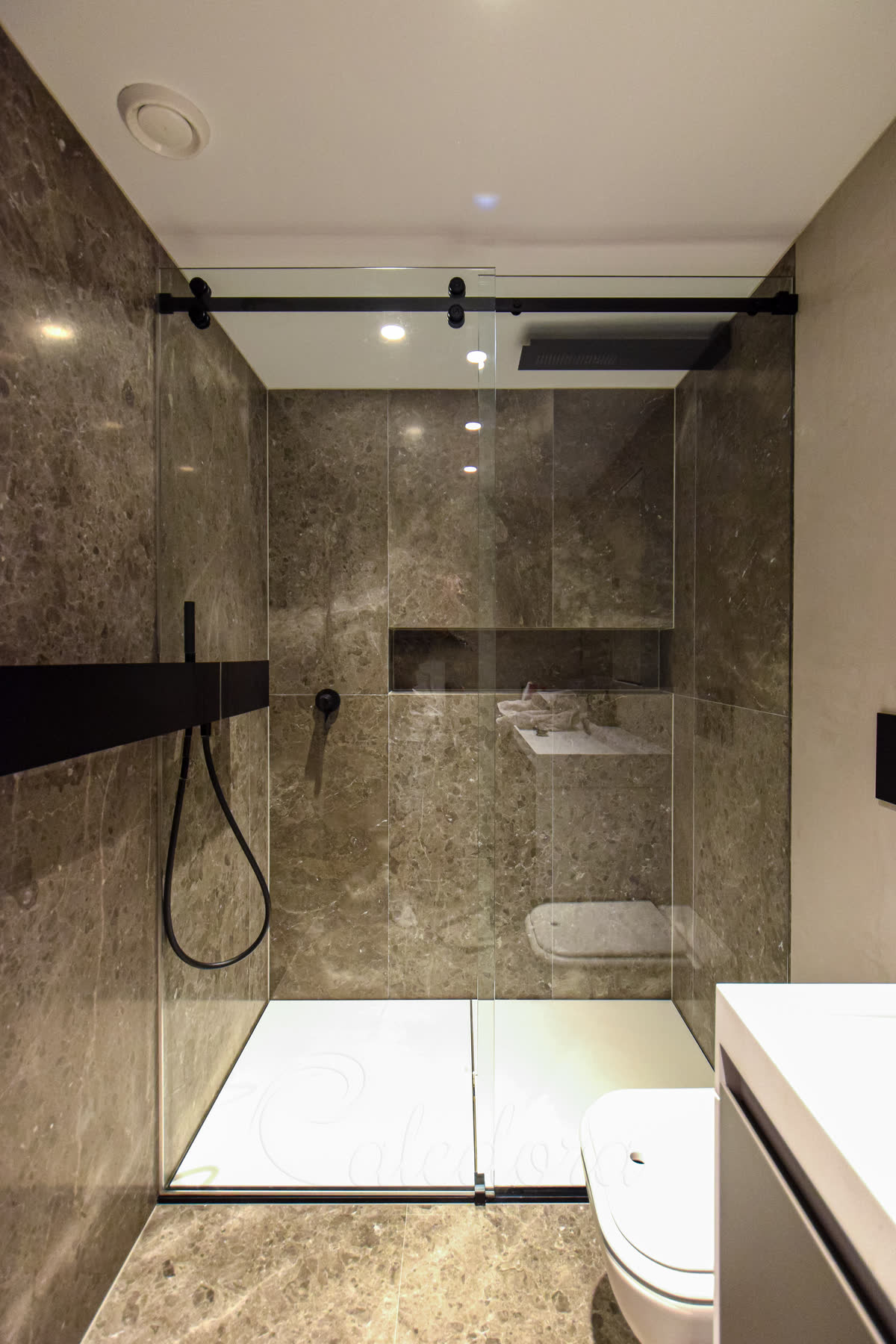
A frameless sliding enclosure is two pieces of glass — the fixed panel and the sliding door — with the track running above. No frame around any edge. The look is clean, the maintenance is light. Hardware comes in supplier-stock finishes — stainless steel and brass, or the black sliding shower doors pictured left — with anodising or powder-coat on box-track extending the range further. Glass is limited to smooth-surface types — the floor guide needs a smooth surface to slide along.
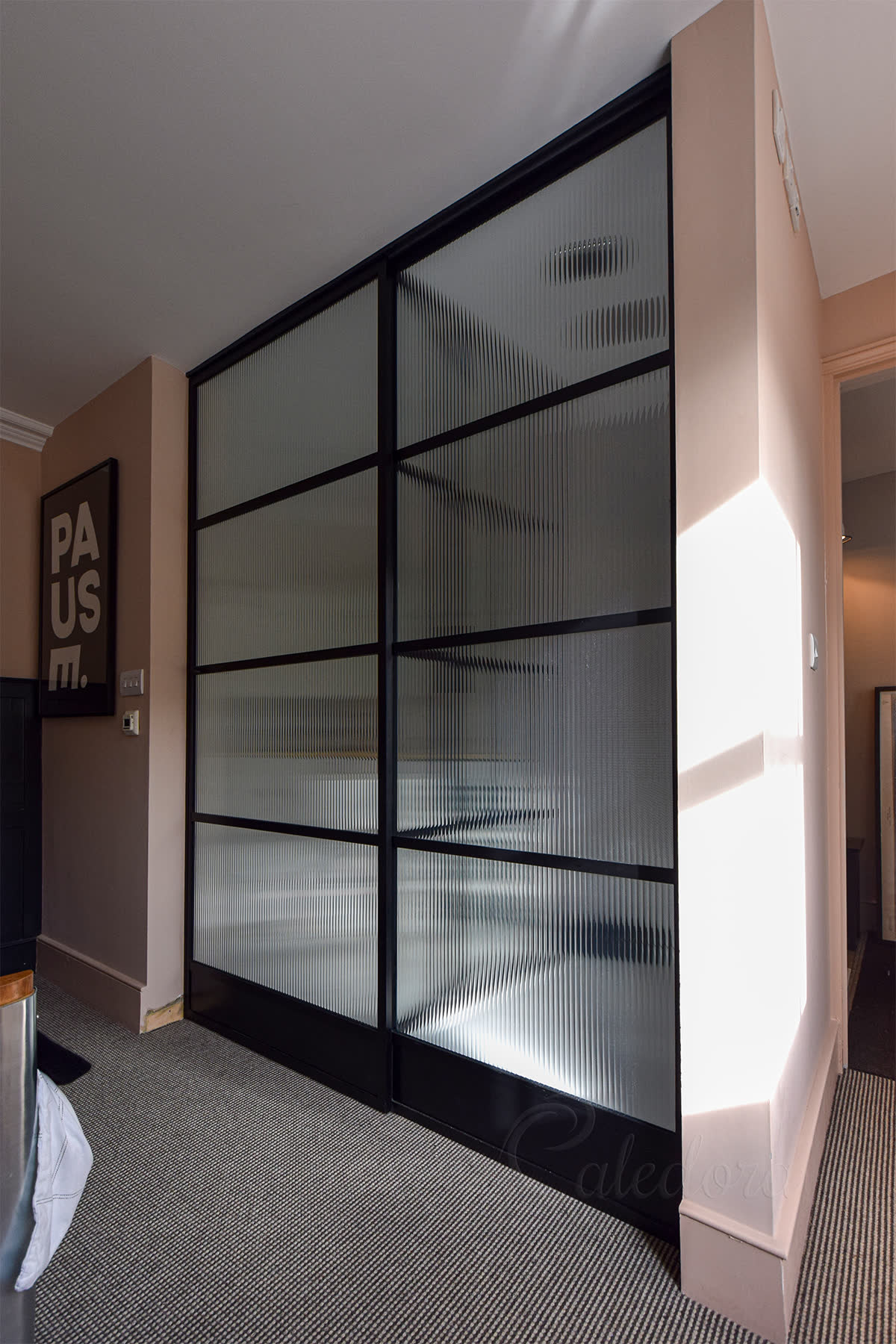
When the design needs a textured or laminated glass surface, the door must be framed. The framed version uses a different floor mechanism — the bottom frame has a groove that rides on a floor pin, so the glass itself never touches the guide. That keeps textured surfaces from line-marking and protects laminated edges from water. Our framed sliding doors are custom-fabricated aluminium, rigid enough to carry the door without flex — never the flimsy off-the-shelf systems sold in DIY stores.
The glass type changes both the look and what kind of sliding system can hold it. Frameless sliding is limited to smooth glass — clear, Ultra Clear, and tints. Textured or laminated glass needs a framed slider, which opens the full glass library.
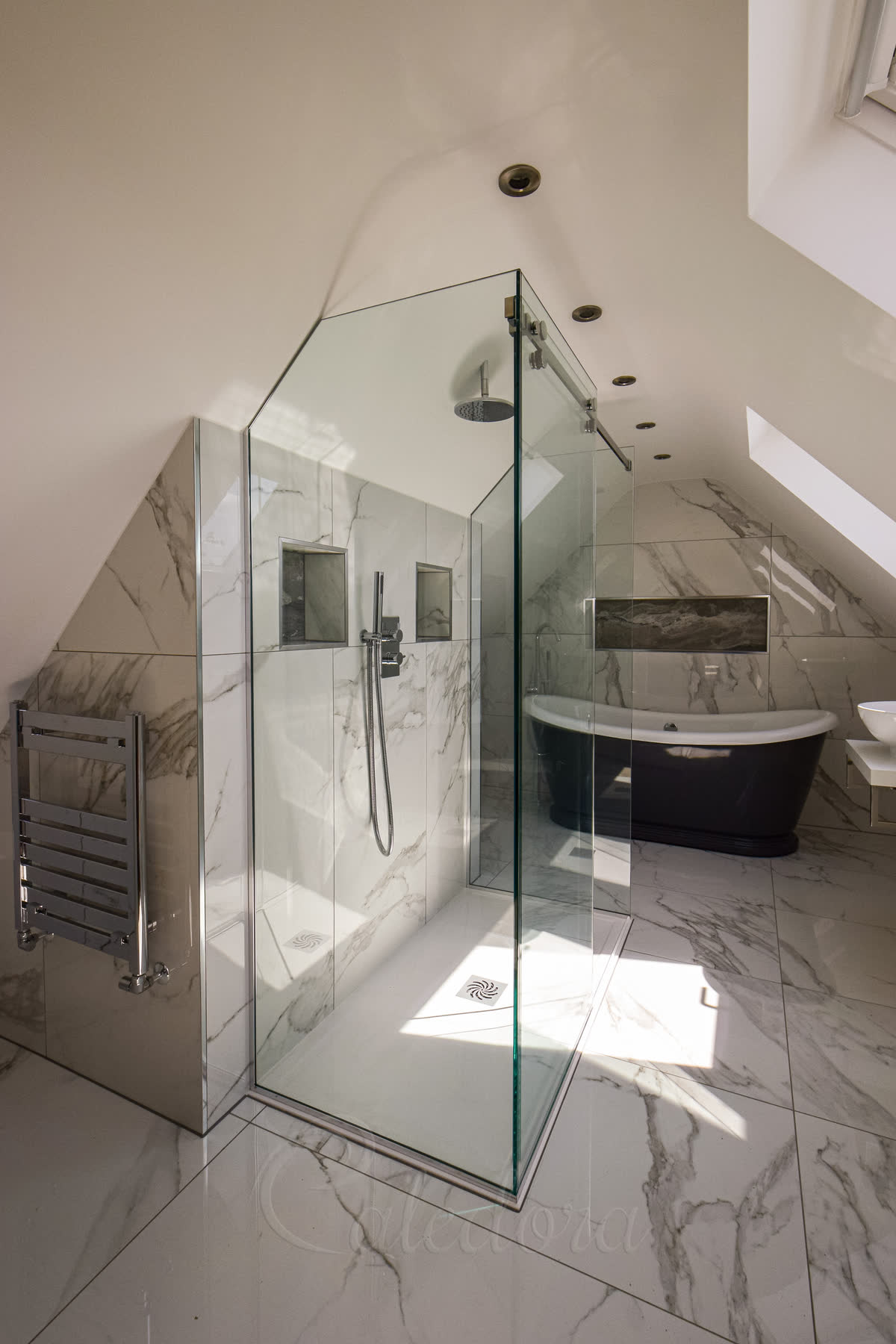
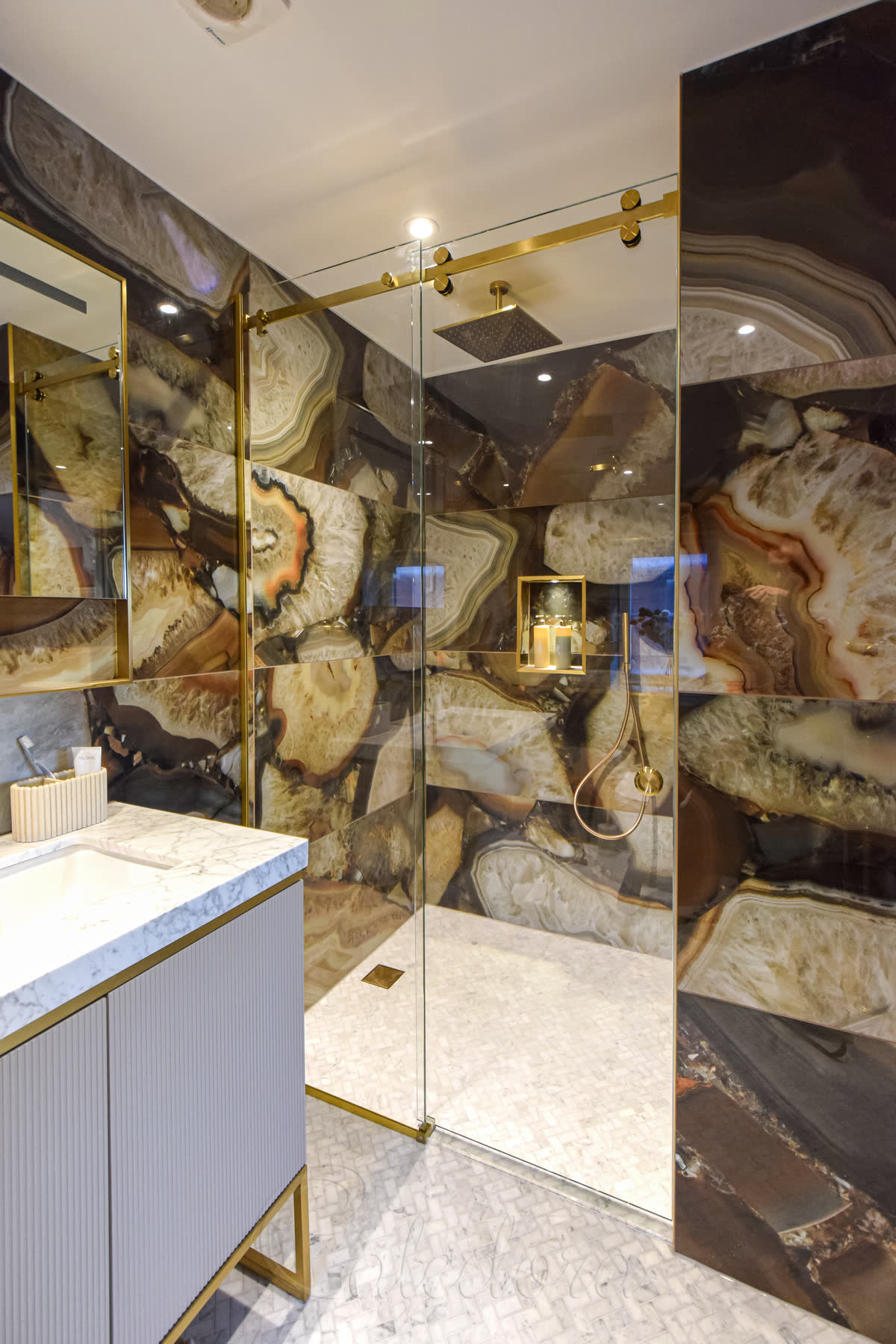
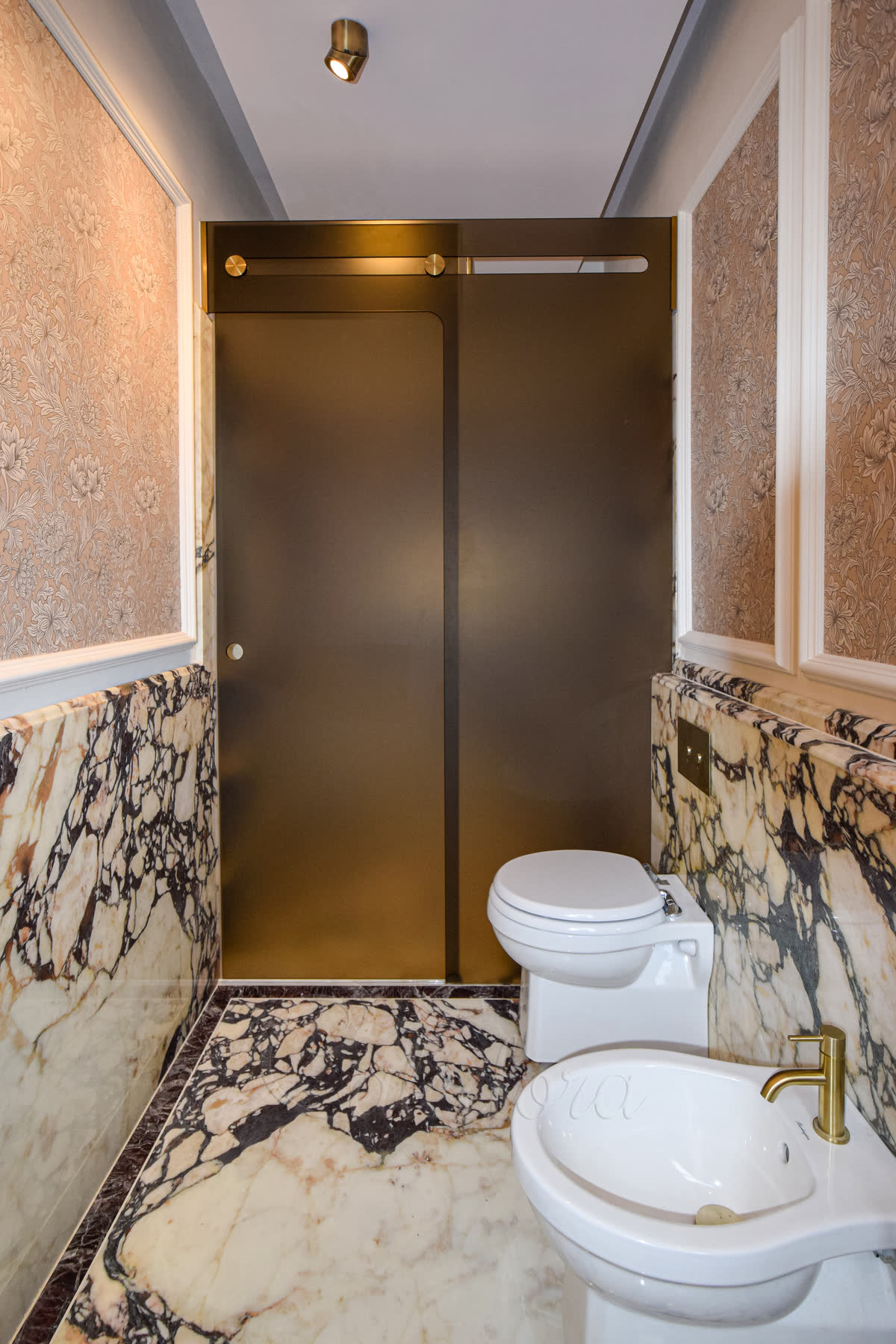
The four glass types that work on a frameless slider all have the smooth surface the floor guide needs: standard clear, Ultra Clear, and two tints — grey and bronze. All come standard with our easy-clean coating.
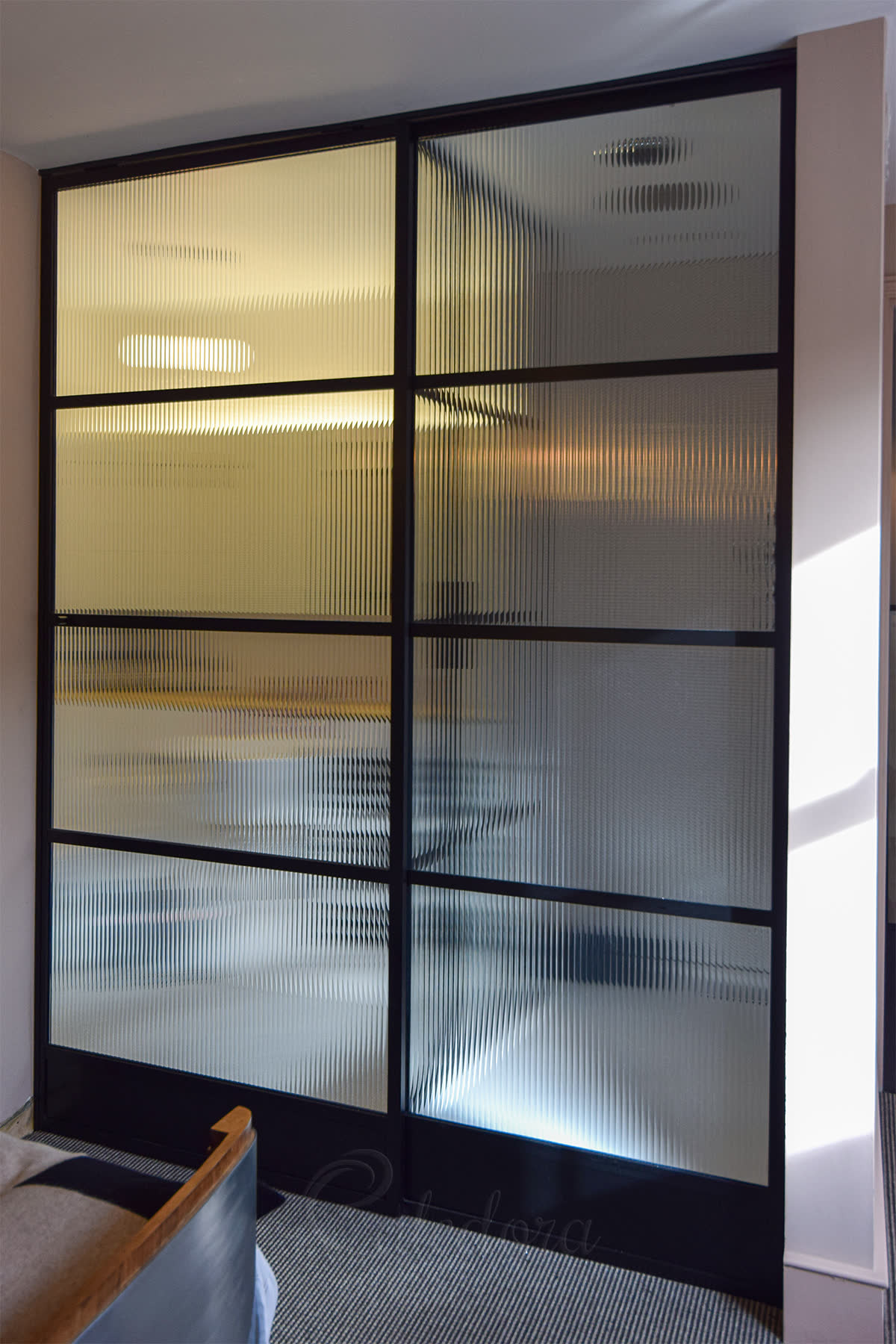
Textured reeded and frosted glass would line-mark on a frameless floor guide — the framed alternative uses a bottom frame that rides on a floor pin instead, so the glass surface is never touched. Laminated glass needs the frame's edge protection from water.
All our sliding glass is 8 or 10 mm toughened safety glass — much thicker than the 4-6 mm panels common in off-the-shelf sliders. Toughened means it shatters into granular cubes if it ever fails. Easy-clean coating included as standard.
Whether framed or frameless, on rollers or trackless, every sliding install we fit includes these four parts — each handles a different job the glass alone can't do.

You can't push a sliding door — it needs something to grip. We prefer a 50 mm polished hole through the glass — clean, frameless, no metal to clean. Positioned at forearm-parallel height (midway on raised trays). Knobs and pulls also available in any matched finish.

At the wall-meeting edge (usually the handle side), the door gets a 7 mm seal bonded with adhesive. On the glass-to-glass joint, we prefer a panel overlap — it routes water through cleanly without a seal. A thin flat seal can be added there too if the showerhead aims that way.

The guide keeps the door's bottom edge tracking straight; the door floats 5–10 mm above the tray. Usually screwed to the tray — gluing isn't reliable. Rollers-on-tube systems can clamp the guide to the fixed glass instead, avoiding tray drilling.

There's no room for a bottom door seal — the floor guide occupies that space. A 10 mm clear acrylic threshold sits in front of the door instead, blocking water at floor level. Not optional on sliding; without it our warranty doesn't cover bottom leaks.
Frameless and framed sliding doors fitted across the UK — every kind of track system, every glass option, every layout shown above. Each picture is a real Caledora install.


4.9 / 5
On Google, Houzz & Trustpilot — from real installs, never paid
10,000+ items fitted
Residential & trade — UK-wide since 2014

Official member
3-year warranty
On workmanship — every install
£5m insured
Public + Products Liability · £10m Employers' — never claimed
A selection of sliding-door installs we feel best match this page — frameless and framed, inline, corner, and over-bath. Click through for full photos, hardware specs, and project notes.


Get professional help choosing the right track system, glass options, and custom sizing for your bathroom. Our expert team guides you through the entire process from design to installation.
Monday-Friday 7:30AM-4PM
Sliding doors need a tray roughly double the door width, because the door slides behind a fixed panel of equivalent size. An inline sliding enclosure works best on trays wider than 1,000mm — anything narrower leaves too little effective entry. For reference: on a 1,000mm-wide opening, the actual entry width after the door slides back is around 450mm (the rest is covered by the fixed panel plus operational clearances). Corner sliding enclosures work from around 800 × 800mm because the entry is diagonally across the corner. If your tray is smaller than either threshold, bifold or hinged is usually the better mechanism.
Depends on your ceiling height, aesthetic preference, and budget. Rollers on a tube (traditional): visible chrome/brass rollers on a horizontal tube; affordable and reliable, but needs ~100mm clearance from the ceiling. Box track: a 50×50mm enclosed aluminium profile above the glass with the carriages hidden inside; supports soft-close mechanisms and more finish options via anodising. Ceiling-recessed: track built into the ceiling so only the glass is visible — cleanest look, needs enough ceiling depth. Trackless: no metal track at all — the door's wheels slide inside a notch cut into the fixed glass panel, needs 250mm of glass above head. Trackless is the premium option; rollers-on-a-tube is the budget default.
Yes, somewhat — by mechanical necessity. Sliding doors use rollers or carriages that glide along a track, with the bottom held in a loose floor guide. The moving hardware makes a subtle rolling sound during operation that hinged doors don't have. Soft-close mechanisms (available on hidden-carriage and ceiling-recessed systems) reduce the slam at the end of travel but don't eliminate the rolling noise. Trackless systems are usually the quietest because the wheels roll inside a smooth glass notch rather than against metal. For most clients the sound is a non-issue — it's comparable to a quiet drawer slide. If silence is a priority, go hinged.
Reeded (fluted) glass, laminated glass, and rough frosted glass all fail frameless sliding. Reeded has vertical ribs that the floor guide rubs against, leaving scratch marks over time. Laminated has a plastic interlayer between two glass sheets — water contact at the exposed edge eventually breaks it down, and frameless doors leave every edge open to water. Frosted glass's rough surface gets line-marked by the floor guide. Your frameless options are clear, Ultra Clear (low-iron), and tinted variants (grey, bronze, green). If you want reeded, fluted, laminated, or frosted on a sliding door, go framed — the frame protects the edges and the door guide sits inside the bottom frame without touching the textured glass.
Yes, on two of our four track systems: hidden-carriage (box) and ceiling-recessed. Soft-close mechanisms catch the carriage at the end of travel and pull the door smoothly to position. We usually fit the stopper at the open end of travel (opposite the handle side) — the handle-side edge has a perimeter seal that cushions against the wall when the door closes, so no stopper is needed there, but the open end has no cushion and would hit the wall hard without one. Both ends can be fitted with stoppers for a symmetrical feel if you prefer. Roller-on-tube systems can't take soft-close because the rollers are visible with no hidden mechanism; trackless systems use wheels in a glass notch without dampening. If soft-close matters, that narrows the choice to hidden-carriage or ceiling-recessed.
Yes — sliding doors don't work without one. The door is held at the top by rollers or carriages and at the bottom by a floor guide that it slides through; the geometry doesn't allow a bottom elastic seal the way a hinged door has. Water protection at floor level depends entirely on the threshold. We install a 10mm acrylic threshold in front of the door, with the gap between the door's bottom edge and the threshold under 9mm — water running under the door hits the threshold rather than escaping. For normal showering, 10mm is enough; if a handheld shower head is aimed directly under the door, even a 20mm threshold can be overflown, so avoid that habit.
Yes — sensor-triggered automatic opening is available on box-track and ceiling-recessed systems, where the closed track interior houses the motor and drive belt. A wall or infrared sensor detects approach and opens the door; it closes after a configurable delay. Useful for accessibility or hands-free use; uncommon in residential because of the cost and maintenance footprint, more typical in commercial wet-room installs. Not available on rollers-on-a-tube (mechanism is exposed) or trackless (no carriage to drive). If automatic opening matters to you, we'll spec the track system around it at the survey.