



Copper
London
Most suppliers stock one fluted glass. We hold three rib textures — and kiln-form a bespoke one when none of the three is right.

Fluted and reeded are two patterns from the same family — ribs standing out of the glass, or grooves cut into it. After the pattern, what changes is the build and the glass under it: a single toughened sheet, a laminate, or a rib kiln-formed to order when no rolled sheet has the one you want. Clear or ultra-clear as standard, tinted grey or bronze where the room asks for it, a frosted interlayer where you want the texture without the view, sandblasting over a formed rib for a softer face. Each a bespoke shower built around the room you have.
Call 0333 090 8736
Monday-Friday 7.30AM-4PM
Fluted glass breaks up the light and blurs whatever is behind it, so the shower stops being on show without the room losing its brightness — people and walls stay visible, just soft. We build it, fluted or reeded, into screens, doors and enclosures. The ribs always run vertically — the full height of the panel, or banded across the middle with clear glass above and below.
A screen has no door, so it is the one place textured glass can go without a frame at all — nothing hinges, so there are no hinges to clamp the ribbed face. It also means the glass can be shaped as well as textured. The one here wraps three sides of a walk-in and leaves the entry open, which is as close to an enclosure as you get without a door. Across our shower screens, a single textured panel is often the whole shower.
A door is different: it must have a perimeter frame. Frameless hinges clamp the glass between rubber gaskets and need a flat face to grip, which a ribbed one will not give them. So the hinges fix to the frame instead, and the frame seals every edge of the panel. Hinged, sliding or bifold, the rule is the same for all three shower doors — and the frame becomes part of the look rather than something to hide.
An enclosure has a door, so it carries a frame for the same reason. What it also has is glass on two or three sides — and that is a lot of open glass. Texture is the middle ground: run it across every side and you keep the light and the reach into all the corners, while the shower itself stops being the most visible thing in the room. Our shower enclosures are made to the corner you actually have.
Nine out of ten people who ask us for fluted glass are picturing reeded, and almost nobody minds once they see it. We explain the difference at nearly every survey — and the people asking are architects, designers and contractors, not people who should be expected to know. So here it is once, properly.
Fluted curves outwards. Each rib is a rounded ridge that bulges out of the face of the glass — convex — with a sharp V where one rib meets the next. Run your hand across it and you feel the ridges standing proud. Light catches the high points, so against a bright wall or a window the panel throws soft vertical shadows down its whole height.
Reeded curves inwards. The exact inverse: the curve is cut into the glass instead of rising out of it, so the face is a run of shallow rounded hollows — concave. It diffuses more evenly and reads calmer, and it is the one that ends up in more bathrooms. The quick test on a photograph: if the curve comes towards you it is fluted; if it falls away from you it is reeded.
And ribbed? Nobody stocks it. No UK supplier sells a ribbed pattern — the word is what people reach for when they want glass with lines in it and have no reason to know which of the two they mean. If you have been searching ribbed shower screens, everything you found was fluted or reeded under a different label, and either way we make it. A squarer, flatter rib can be kiln-formed to order if that is genuinely the look you are after, but it is a rare request.
Rib size is the choice most people never realise they are making. It changes the character of a panel far more than it changes what you can see through it, and the three we hold cover almost every bathroom we are asked about. Beyond the three, glass can be kiln-formed to order — the rib melted in rather than rolled — which opens shapes and spacings no standard sheet offers. That costs more than rolled glass, and it is made to order rather than held in stock.
Fluted
The finer of the fluted steps, and the busier. At arm's length the ribs read as texture rather than as separate lines, which suits narrow screens where a coarse rib would look striped rather than designed. A single 8 mm toughened sheet — strong enough on its own, so no lamination.
Reeded
The standard reeded pattern in UK supply, and the one most people picture when they say fluted. The word comes from Pilkington, who make it — they named the concave one reeded, so the trade followed, and fluted stayed with the convex. It arrives as a 4 mm sheet, too thin for a shower alone, so we laminate it to 4 mm ultra clear. The finished thickness lands around 9.2 mm, give or take: the interlayer between the two sheets comes in 0.6, 1.2 and 1.5 mm, and which one we use depends on the panel. Framed installs only.
Deep reeded
A tighter curve and a deeper hollow, so the relief is far more pronounced — the one to choose when the glass is meant to be the feature rather than the backdrop. It comes as a single 10 mm ultra-clear sheet, which matters if ultra clear is what you are after: no laminate, and none of the green cast standard float carries.
The three profiles above are the ones we hold. When none of them is right, the glass is made rather than bought — the rib melted in on a kiln bed instead of rolled at the factory, which puts the width, the depth and the shape of every rib up for decision. It is dearer than a stock sheet and it is made to order rather than held, so it is not the default answer. It is the answer when the room needs something that does not exist yet.
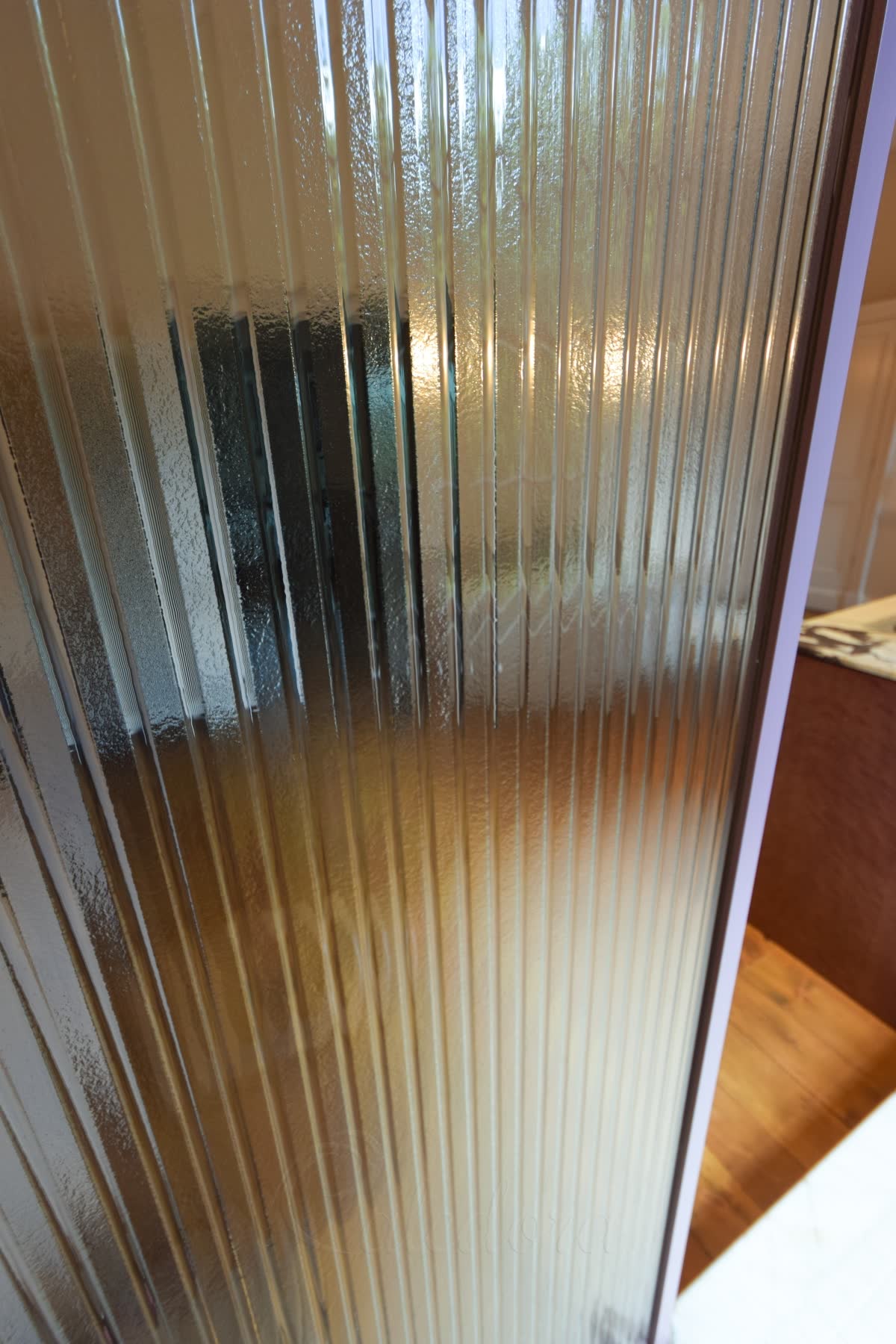
Rolled glass comes in the widths the factory rolls. On a kiln bed the pattern is set by what the glass is melted over, so the ribs can be far wider than any stock sheet, or narrower, and they need not be true curves at all — laid over square beads the result is flat-faced with softly rounded corners rather than scalloped. That is the glass here, close up. It went into a screen framed in powder-coated purple, because the texture carries no colour of its own and leaves the frame free to be any shade you like rather than the usual black or brass.
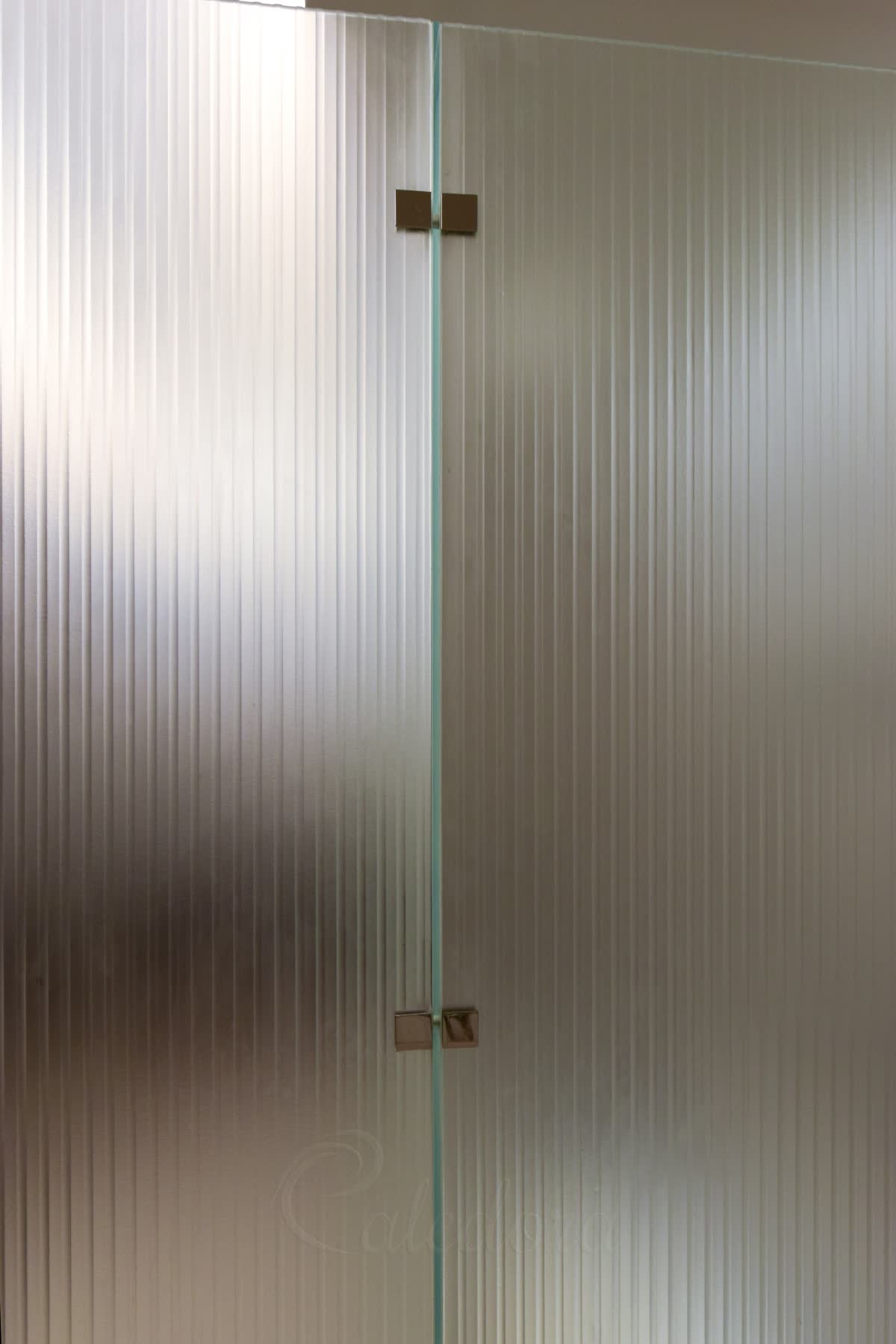
A formed panel is still glass, so it can be treated afterwards. Sandblasting over a kiln-formed rib softens the face and takes the privacy up without losing the texture underneath — that is the close view here, two panels meeting at a bracket. In the room they came from, a panel like this carries the screening on past the enclosure itself, closing off a corner the shower alone would have left open. The same glass can be laminated, tinted, or cut to a shape, in whatever combination the room actually needs.
More than people expect, and that is rather the point of it. Textured glass does not hide the shower the way frosted does — it blurs it. Shapes, colours and the wall behind stay readable; detail does not. Someone on the other side is plainly a person, plainly moving, and that is as far as it goes, so the bathroom keeps its light and its depth instead of ending at a white panel. If you want a number to hold on to: reeded glass gives you roughly half the privacy of frosted.
Privacy is not a single setting. Between clear glass and frosted there are two useful stops, and the second of them is the one almost nobody knows about — a panel that looks like ordinary reeded glass from the outside and hides almost everything. Whether half is enough, or whether you need the step beyond, depends entirely on who else uses the room.

No privacy at all and maximum light — the right answer more often than people assume, in an en-suite one household uses or a shower nobody overlooks. Worth ruling out deliberately rather than by default: plenty of rooms that end up textured never needed to be.
You can see that someone is there and roughly where they are, and no more than that. The texture does a second job as well: it draws a line between the shower and the rest of the room, and it disguises the water marks on the inner face, so the glass looks clean for longer between wipes.
Frosted works by distance. Stand ten to fifteen centimetres back from the glass and your shape is already unrecognisable; press a hand flat against it and that hand stays clearly visible. In a shower the first case is the normal one, so in practice it hides what it needs to.
The step past frosted, and the one people do not know to ask for. Reeded glass laminated over a milky interlayer reads as ordinary reeded from the outside — same ribs, same light — while the view through closes to almost nothing. Not quite nothing: stand close enough to nearly lean on it and a shape appears. Anywhere further back, there is nothing to see. The screen pictured separates a bedroom from a wet room, which is about as much as anyone asks of glass.
A fluted or reeded door is always built into a metal frame. It is not a house style and it is not a shortcut — there are two separate reasons, and each one on its own would be enough. A panel that does not move is a different case entirely.
Reeded glass comes 4 mm thick and is not strong enough for a shower on its own, so we bond it to 4 mm ultra-clear behind it — around 9 mm finished, depending on the interlayer. Fluted at 8 mm is a single sheet and needs no lamination at all.
A frameless hinge grips like a clamp — a rubber gasket against each face of the glass, and a metal plate pressing on each gasket. On ribbed glass the gasket only meets the tips of the ribs, so well over half the grip is gone before you start. Water and soap then run into the channels between rib and rubber and take the rest: the door drops, shifts, and hangs out of square.
A frameless edge is an open edge — air and water reach the laminate directly, and once moisture is into the interlayer the damage does not come back out. A frame is bonded to every edge of the panel, which seals the laminate and protects it. The hinges then fix to the frame rather than through the glass.
A panel that does not move has no hinges to clamp, so the second problem disappears — but the first does not, and a laminate still needs its edges sealed. Choose a single sheet and both are answered at once: 8 mm fluted, or 10 mm ultra-clear deep reeded, with no interlayer to protect. That is what makes a frameless fixed screen possible.
Texture out, smooth in. We fit fluted and reeded glass with the ribs facing the bathroom, and two separate reasons pull in the same direction. The first is that the texture is the thing you bought — facing outward it catches the room light, it reads properly from where you stand, and it is there to touch as you walk past. The second is cleaning, and day to day it matters more.

Inside the shower — the face taking the water, the soap and the limescale — the glass is flat. A squeegee crosses it in one pass, exactly as it would on clear glass. Turn the ribs inward and every one of those grooves becomes a channel to work along, every single time.
The textured side still wants an occasional wipe, but it is dealing with steam and dust rather than shower water and shampoo. That is a different job, and a much less frequent one. Our covers what textured glass actually needs.
Ribs facing the room are ribs you brush past. Fluted and reeded glass is chosen as much for how it feels and how it breaks the light as for what it hides — turn it inward and you have paid for a texture that only the shower gets to enjoy.
Texture is a neutral. The glass carries no real colour of its own, so what the metal does with it is the whole design decision — and some pairings are a great deal better than others.

The one everybody comes for, and rightly. Slim black bars divide the panel into panes, and the vertical ribs inside each pane give the eye something to hold that clear glass never does — black framing with clear glass looks plain beside it. It is the pairing we build most often, which is why most of our textured work is black shower screens and enclosures.

Warmer, and more traditional. Unlacquered brass in particular belongs with textured glass — both age, both have a softness to them, both sit naturally in an older British house rather than being imposed on it. Brass shower screens with reeded glass are the closest thing we make to a period fitting.

Between the two, and underused. Darker than brass and warmer than black, so it lets a heavily textured panel be the loudest thing in the room without competing with it. Bronze also holds its own against strong tile and dark stone, where black can disappear and brass can shout.

The soft option, and routinely overlooked. Not every bathroom wants a hard line drawn round the shower — in a pale, calm room with cornice and panelling, black reads as an intrusion and brass as a statement. A painted frame dissolves into the joinery instead, and leaves the texture of the glass as the only thing you notice. Any RAL colour, so it matches the room rather than contrasting with it.
A panel does not have to be all one thing. We can run clear glass along the bottom and the top with a textured band across the middle, so the screen hides you exactly where it matters and stays completely open everywhere else.
The clear strip at floor level keeps the tiling and the tray visible, so the shower reads as part of the bathroom instead of a box sitting inside it. The clear strip at the top lets the light through and stops a tall screen feeling like a wall. The band in between does the only job privacy actually requires. Chest height is the usual answer for where that band sits — it does not have to be.

Underneath, the panel is a single full-height sheet of ultra-clear glass, with clear and textured face sections laminated onto it in the zones you choose. That is what keeps the panel strong and flat while the face changes character partway up — you are not butting separate pieces of glass together and hoping.
Laminating sections onto a backing sheet means joints between them, and every joint has to be closed and protected from water. So this is grid work by necessity rather than by taste — the bars sit exactly where the sections meet, and their job is keeping moisture out of the lamination. It happens to look good, which is a fair coincidence.
Textured glass does not have to be a rectangle. The top edge can be arched, angled to a sloping ceiling, or cut around whatever the room happens to do — the ribs run vertically regardless of what the outline is up to. The screen here has an arch cut into its top edge; the same cutting works to a roof pitch, around a bench, or to whatever line the room sets.

ARCHED
Worth clearing up, because the search results are full of it: an arched screen is not curved glass. It is a flat sheet with a curve cut into the top edge. People say curved because they can see a curve, which is fair enough — but the two are completely different pieces of work, and only one of them is what almost everyone actually wants. Shaping is also easiest on a fixed panel, where there are no hinges to work around.
Glass bent into a true curve and then toughened can be made in fluted or reeded. It is not a limit of the material. We have simply never had a client ask for one, so we would rather say that plainly than pretend it is a standard line on the price list. If it is what your room needs, ask and we will quote it properly.
Textured glass across screens, doors, enclosures, partitions and bath screens — black grid, brass, bronze, painted and kiln-formed. One picture from each installation, every one designed, made and fitted by Caledora.


A handful of showers we have designed and fitted in textured glass — screens, doors and enclosures, in black grid, brass and painted frames. Each one made for a specific bathroom; click through for full photos, hardware specs and notes.


Send us the room — measurements if you have them, photographs if you do not. We will tell you which profile suits it, whether the panel needs laminating, and what the whole thing costs: survey, design, manufacture and installation.
Mon–Fri 7:30 AM – 4:00 PM · Most quotes returned within 2–3 working hours
Fluted glass has rounded ribs standing out of the surface with a narrow V-groove between them — positive relief you can feel with your hand. Reeded glass is the opposite: rounded grooves cut into the surface, giving a scalloped face. Both run vertically and both belong to the same family. Most people use the two words interchangeably, including a good many suppliers, so it is always worth checking which one you are actually being quoted.
Partial privacy. It blurs shapes and movement without hiding them — roughly half the privacy of frosted glass. Someone on the other side is plainly a person and plainly moving, and that is as far as it goes. If you want the textured look with full privacy, the glass can be laminated with a frosted or white layer behind it, which looks identical from outside and closes the view down to almost nothing.
No. There is no ribbed pattern in UK supply — it is simply the word people use for glass with lines in it. Whatever you have found sold as ribbed will be fluted or reeded underneath, and we make both.
You do not. We fit the glass with the texture facing out into the bathroom, so the face inside the shower — the one taking the water, the soap and the limescale — is flat and takes a squeegee in one pass, exactly like clear glass. The textured side only ever sees steam and dust, so it wants an occasional wipe rather than routine work.
No, and for two separate reasons. Frameless hinges clamp the glass between rubber gaskets and need a flat face to grip; vertical ribs stop the gasket seating and cut the clamping strength roughly in half, so the door drops and shifts over time. A frameless edge would also leave the laminated interlayer open to water. A fixed fluted panel with no door is a completely different case — no hinges to clamp, so it can be installed without a frame.
Yes, and by a real margin — textured glass costs several times what clear costs. It is priced by the square metre like any other glass, as long as the panel fits within standard sheet sizes. You will see it separately on the quote: the shower itself is one line covering everything from survey through to the final clean, with clear glass and black frames as the standard inclusions, and every upgrade — textured or ultra-clear glass, a brass or bronze finish — added as its own line, so the cost of each choice is visible rather than buried. Reeded adds one more step again: it comes as 4 mm and has to be laminated to 4 mm ultra clear before it can go into a shower.
Arched, yes — the curve is cut into the top edge of a flat sheet, and that is what almost everyone means when they search for curved fluted glass. The same applies to panels angled to a sloping ceiling or cut around an obstacle. Glass genuinely bent into a curve and then toughened can also be made in fluted or reeded, but we have never been asked for one, so treat it as a special order rather than something we hold.