






Stainless Steel
London
Privacy that keeps the daylight. Frosted all over, in a pattern, or only where you need it.

Frosted shower glass gives you privacy and keeps the daylight. Its roughened face spreads the light, so shapes behind it blur while the room stays bright. We make it in three ways: acid-etched, sandblasted, or laminated with a milky layer inside. You can choose the one that suits your glass, your pattern and your room. It can frost a whole panel, fade from frosted to clear, or leave a clear band where you want a view.
Every frosted shower door, screen and enclosure is surveyed, made in our workshop and fitted by our own team, like all our bespoke shower glass.
Call 0333 090 8736
Monday-Friday 7.30AM-4PM
Frosted glass is clear glass with one face roughened. The rough face catches the light passing through and spreads it in every direction. It works like the diffuser on a ceiling light or an LED panel: the light comes through soft and even, but you never see the bulb. So shapes behind the glass blur, but the light still gets through. You get privacy without a dark corner.
True frosting changes the glass itself, so it cannot peel or lift. The surface is roughened by acid, or by a blast of fine grit. Today that grit is aluminium oxide, which replaced sand because it is safer to work with. Films, lacquers and paints only cover the glass, so we do not count them as frosting. The matt face can carry a band or a fade, graphic patterns, even designs as detailed as a painting.

Frosted glass reads more like a wall than clear glass does. It separates the shower from the room, and its white tone makes a bathroom feel a little cooler. For a shower beside a bed or a door, that clear separation is often the point.
The cooler feel is much smaller when only the lower half is frosted. The clear top keeps the room open and warm, and the privacy sits where it is needed: below, where the body is.
Any glass we make can be frosted: a door, a fixed screen, a full enclosure, or the door to the toilet next to the shower. The glass is made to the same sizes and fitted with the same hardware as clear glass. What changes is where the frosted face goes and, on one kind of door, how the door is held.
Open any one below to see it.
A frosted door swings on the same hinges as a clear one, framed or frameless. The frosted face goes on the outside, so the shower side stays smooth. Sliding doors can be frosted too. On a frameless one, the floor guide brings one risk, explained further down the page. See all our glass shower doors.
A fixed screen is where frosting is most often partial. The lower half can be frosted for privacy, with clear glass above to keep the view open. Or a band can run across the panel at the height that matters. A walk-in screen with no door is often frosted this way, so the open side still feels open. Over a bath, a folding screen can be frosted all over, like this one. More on our glass shower screens.
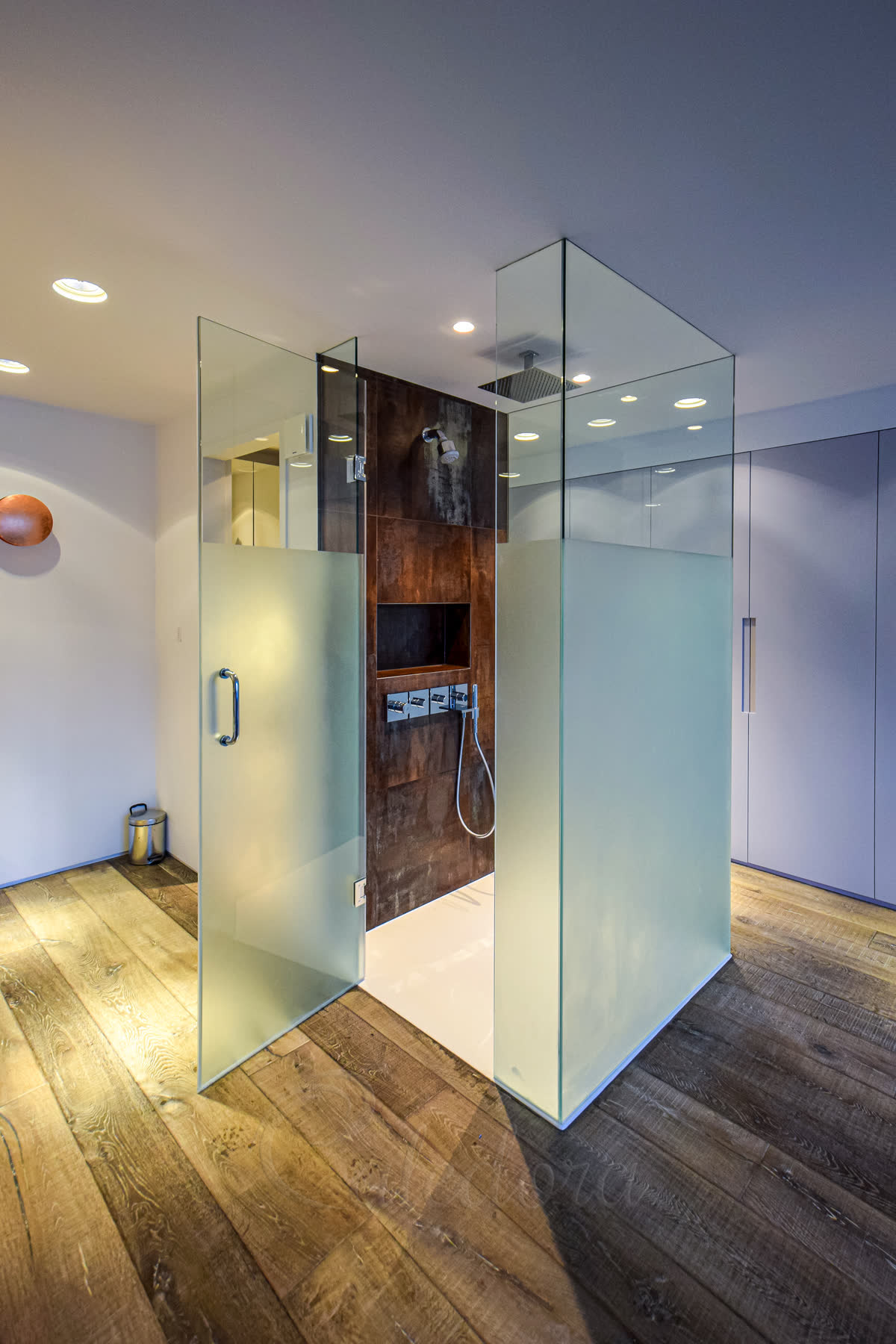
A frosted enclosure turns the shower into its own small room. Glass to the ceiling, frosted on every side, reads almost like a wall, yet it still lets the light through. It suits a shower in a bedroom, or a bathroom that two people share. The door and the fixed panels match, so the enclosure reads as one piece. See our glass shower enclosures.
A glass partition, the toilet door or the bedroom door can be made in the same frosted glass as the shower. The partition in the picture is acid-etched glass, and it slides, frameless. Inside a shower, the frosted face always goes outside. On a WC or internal door, it can face either way. The rough side looks matt and the other side stays smooth and glossy, so we choose with you which room sees which.
Frosted glass looks like one thing, but it is made in three different ways. Two of them roughen the face of the glass: acid, or a jet of fine grit. The third leaves both faces smooth and puts the white inside the glass. Each one has a job it does best. Which we use depends on the pattern, the glass and the door.
Acid-etched glass is frosted at the factory, a whole sheet at a time. Acid treats one face and leaves a fine, even grain. The panel is then cut from that sheet and toughened, and the frosting comes through unchanged. So the finish is the same from edge to edge. It is the simplest way to frost a whole panel, and the one we use most.
Sandblasting frosts the glass with a jet of fine grit, driven by compressed air. It can frost the whole panel or only part of it, in a band, a fade or a pattern. It works on any glass, tinted or Ultra Clear included. It is done after the glass is toughened, and the face is then coated against fingerprints.
Two sheets of toughened glass are laminated with a white layer between them. Both faces stay smooth, because the white is inside. It can look whiter and hide more than either kind of frosting, and it stays private when wet. The laminate needs its edges sealed, so we make it framed only.
Acid-etched glass is frosted before it reaches us. One face of a large sheet is protected, and the other is exposed to hydrofluoric acid, one of the few acids that dissolves glass. The acid removes a microscopic layer and leaves a fine, even texture of tiny pits. Those pits scatter the light, so the view blurs while the light still comes through. The frosting is the glass itself, not a coating, so it cannot peel or fade.
Surface
Seen close up, a sandblasted face is a field of sharp peaks and deep valleys. An acid-etched face is much finer and more even, so it feels velvety to the touch. It does not hold oily fingerprints and is much simpler to clean. So we never coat it, unlike sandblasted glass. The tall panels in this pool room show how evenly it reads.
Glass
Acid-etched glass is mostly made on standard clear glass. Clear glass has a slight green tint, which shows at the edges and in white bathrooms. Acid-etched glass on Ultra Clear, the low-iron glass without that tint, does exist. It is needed so rarely that it is hardly ever kept in stock.
Thickness
Acid-etched glass is mostly stocked in 10 mm, or in thinner 4 and 6 mm sheets. 8 mm can be ordered, but few keep it, because it is rarely asked for. Partial etching is possible too, but it is far more trouble than sandblasting. So where the glass, the thickness or the pattern rules acid-etching out, we sandblast instead.
Sandblasting frosts the glass with fine aluminium oxide grit, blown at it by compressed air. Changing the pressure, the nozzle and the grit changes how rough the face becomes. It can be kept to chosen areas, so only the parts you choose are frosted. It is an extra process on top of the glass itself, so we choose it for a reason. These are the reasons.
When we sandblast
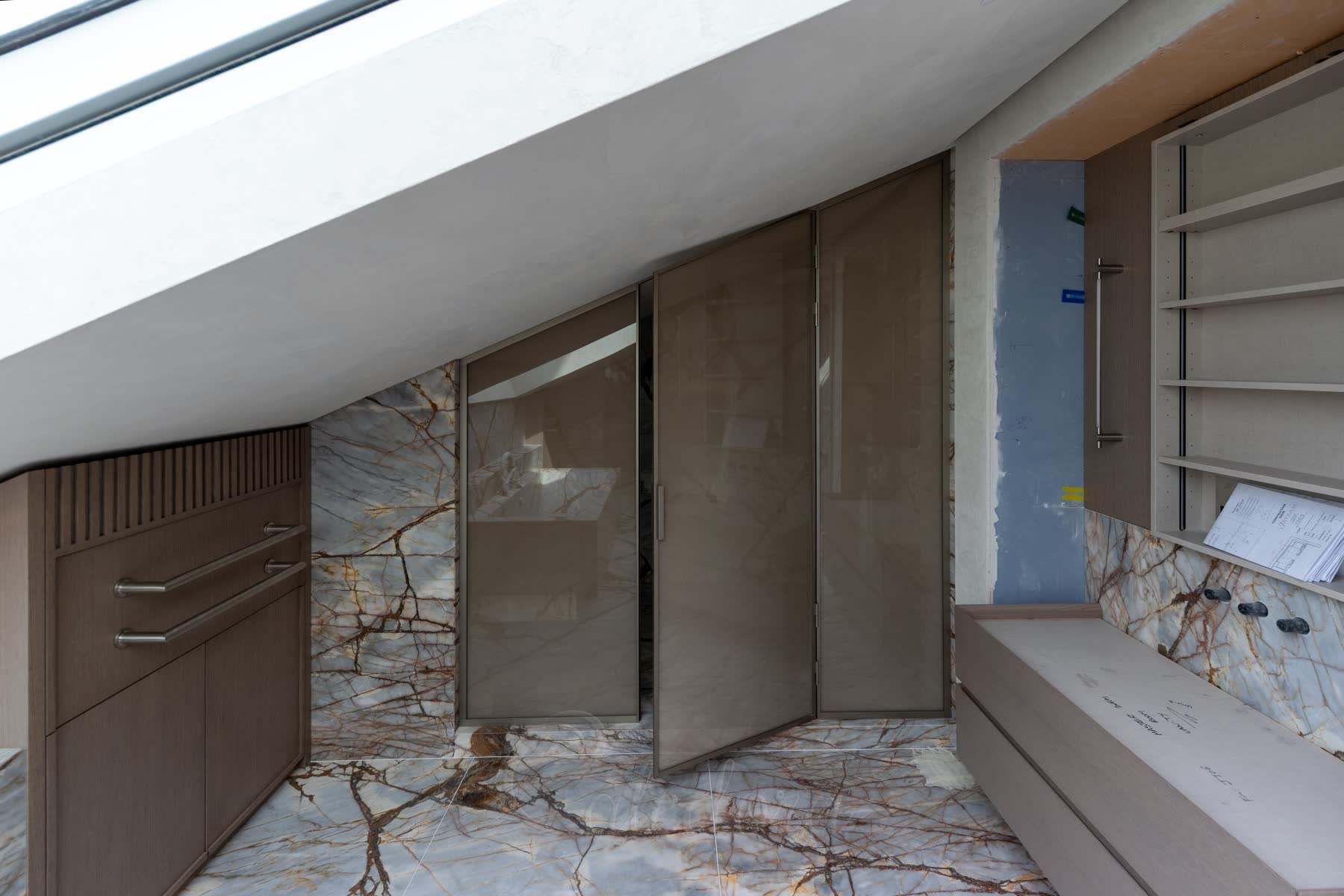
The door in the picture is bronze glass. Bronze is not made acid-etched, so it had to be sandblasted. The panel was toughened first and sandblasted after. That is the order we prefer. Glass can sometimes break in toughening, and a panel sandblasted first would be lost with all that work. The same rough face was given an easy-clean coating, so fingerprints do not stay on it.
A shower rarely needs privacy from floor to ceiling. It needs it where the body is. So the glass can be frosted below and left clear above. The privacy sits where it matters, and the clear top keeps the view and the sense of space. A plain split is the simplest way to do it. Lines and patterns build on it, and sandblasting can take it much further.
The simplest part-frosted panel has two zones. One is frosted, the other is clear, and a crisp line runs where they meet. The line sits where privacy is no longer needed, so the top of the glass stays open. On this enclosure the clear band runs along the top of every panel. It is sandblasted on a single sheet of glass. There is no laminate to seal, so it suits frameless shower enclosures like this one.
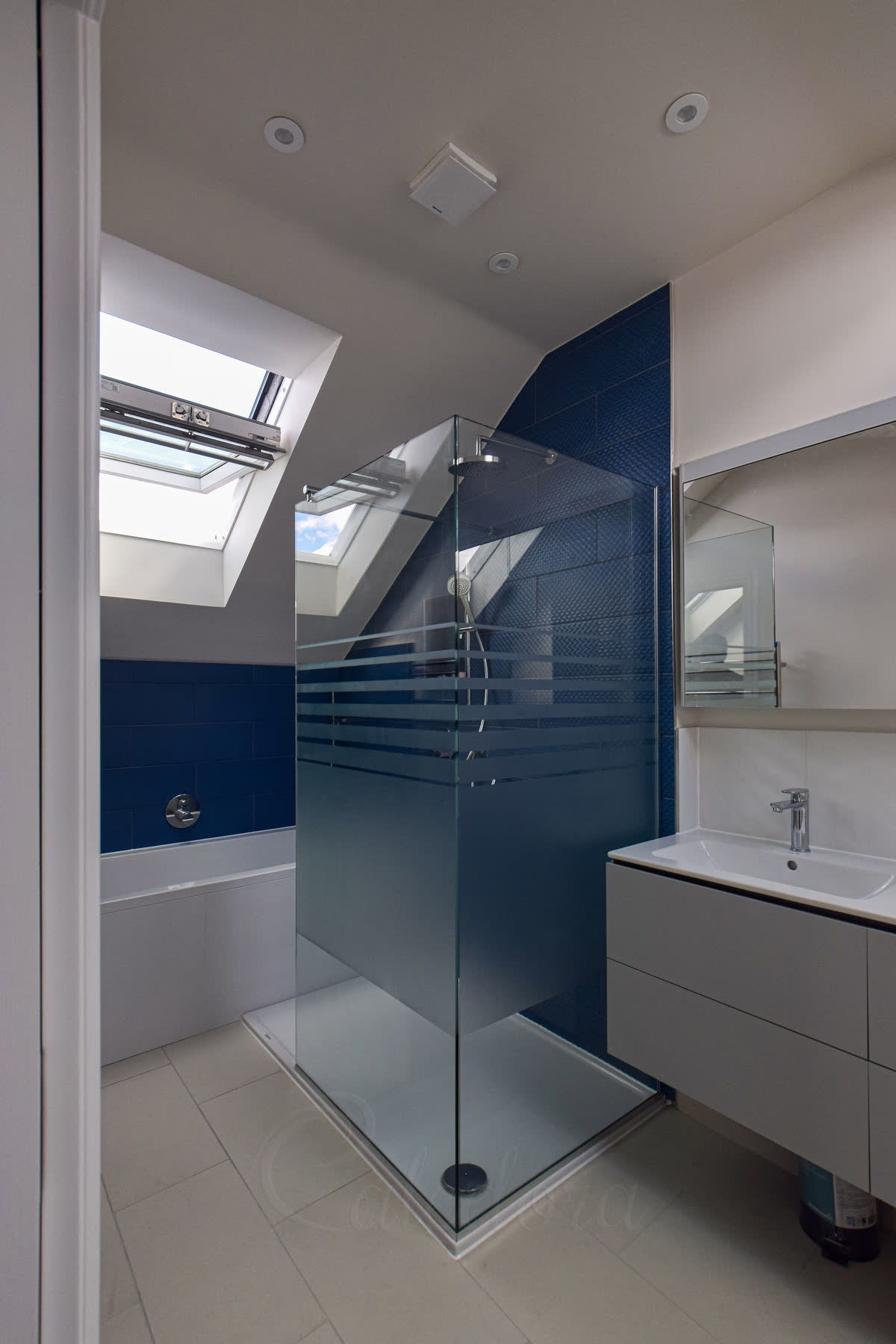
Lines improve on the plain split. Here a frosted band crosses the middle of the glass, and its top edge breaks into stripes. Bands and stripes are only the start. By changing the pressure, the nozzle and the grit, sandblasting can draw graphic patterns and shaded designs as detailed as a painting. A design is not limited to two zones or straight lines.
A gradient does the same job as a frosted line, in a more personal way. You can shower without worrying about who walks in: a child, a guest, anyone, if the door was left open. The frosting builds up gradually, so the glass grows more private the closer it gets to the parts you want hidden. There is no hard edge to catch the eye. Many people do not want the same shower as everyone else, and a gradient is one way to make yours your own.
Sandblasted gradient
On frameless glass the gradient is sandblasted on the face. The blasting flow is controlled across the panel, so the frosting thins out until the glass is clear. Done with care, it shows no lines and no steps, as on this enclosure. The glass is toughened first and sandblasted after. Then the frosted face is coated, like every sandblasted panel.
In a frame, the fade can be printed instead. A printed film is laminated between two sheets of glass. White can rise halfway up the panel and fade to clear, and both faces stay smooth. A laminate needs its edges sealed, so this way is framed only. Ceramic paint is one more option. It is baked into the glass before toughening, in white or soft pastel colours.
A freshly sandblasted face is rough on a tiny scale, and that roughness holds on to things. Oily fingertips leave marks that stay. Soap and grease settle into it, and it soon looks messy. Left like that, sandblasted glass would look worse every week. So no sandblasted panel leaves us untreated.
After sandblasting, the glass is cleaned and the frosted face is coated. The coating is made for rough glass. Once it is on, the glass can be touched and washed without keeping the marks. You can then clean it like any other shower glass.
The coating also changes the look a little. Raw sandblasting is bright and chalky white. Coated, it turns a softer white, close to acid-etched glass. So a sandblasted door beside an acid-etched panel is a close match, though not identical.
The coating lasts about five years. It sits on a rough surface, so cleaning wears it slowly, and harsh cleaning wears it faster. When it thins, the glass starts to hold marks again. It can then be renewed with the same treatment, and the glass is as good as before.
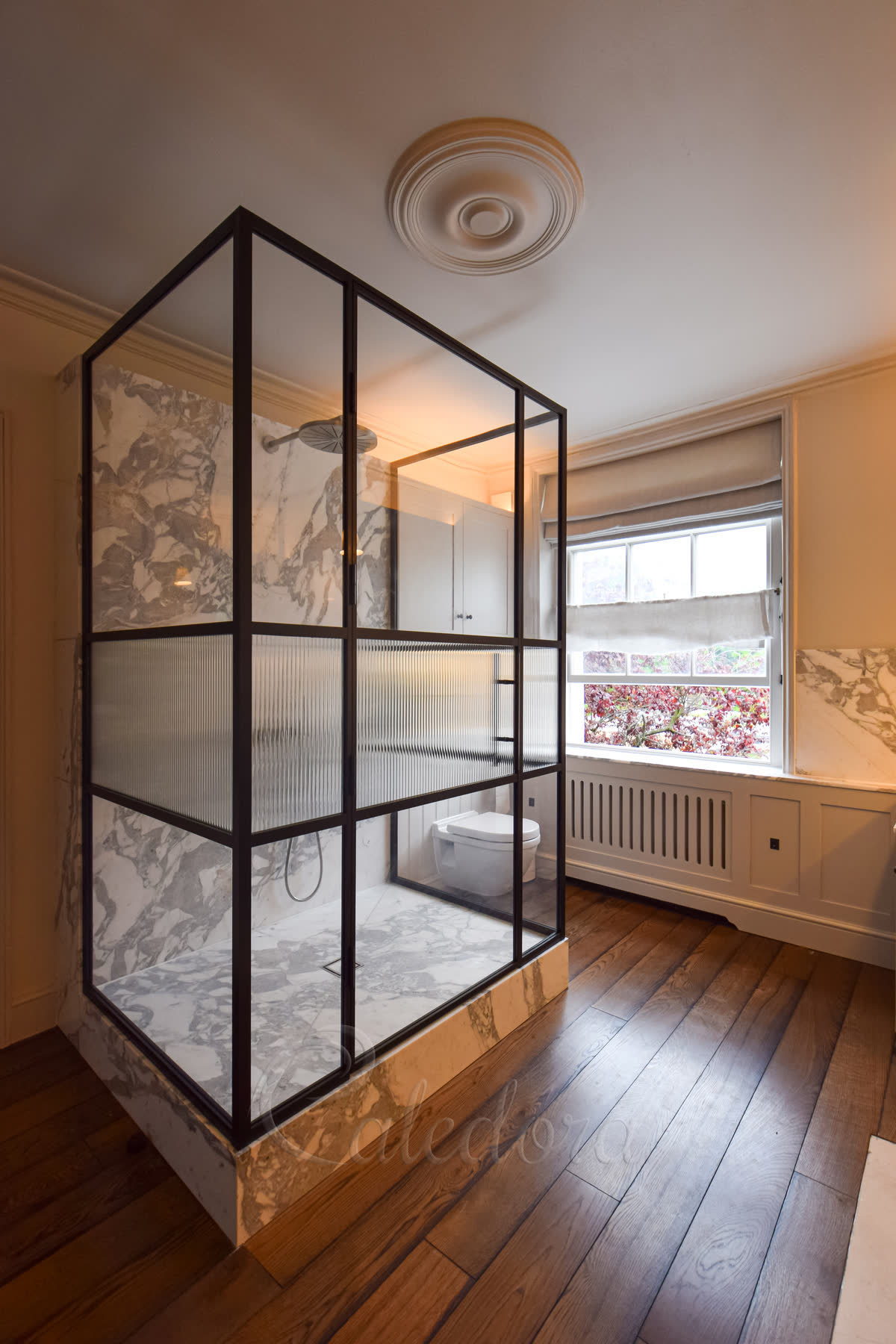
The third way works inside the glass. Two 4 mm sheets are laminated with a milky interlayer between them, white all over or only in part. Choose it when you do not want a rough face on either side, or want a more solid white than frosting gives. It also lets two different glasses work together, like the reeded face of this job. A laminate needs its edges sealed, so we make it framed only. In this job the frame came first anyway, because a black grid is built from frames.
The interlayer does not have to fill the whole panel. It can be white only in part, such as a band at body height with clear glass above it. A printed interlayer can even fade from white to clear, as described above. And white is only one colour. Pink, blue, yellow and many others can be laminated the same way.

Frosted glass turns clearer when water fills its rough face. A milky interlayer has no rough face to fill. The white is sealed inside the glass, so it gives the same privacy wet or dry, on either side.
Both sheets are toughened first, then laminated. If one sheet breaks, the other holds it. If both break, the interlayer holds the pieces together, so they do not fall onto the floor. The frame seals the edges of the laminate and protects it from water.
Frosted glass is one kind of privacy glass, and there are others. Some people find a fully frosted panel a little cold. Texture or metal inside the glass can hide the shower too, with a warmer look. Smart glass works another way. At the press of a button it turns from milky to almost clear, and back again. We fit it too. Below are the two warmer ways.
Fluted glass works with ribs, not a fine frosted grain. Frosting scatters light in every direction. Each rib bends it one way, so what is behind breaks into soft vertical lines. On this enclosure a fluted band runs across the middle, where the body is. Clear glass sits above and below it, so the black grid still reads as one clean frame.
Fluted glass hides less than frosted glass, about half as much. When that is not enough, reeded glass can be laminated to an Ultra Clear sheet over a milky interlayer, as in the loft partition above. From outside it shows the same ribs and the same light, but the view through it closes to almost nothing. Both ways are framed, which suits a grid like this one.
Metal mesh is one more privacy glass. The mesh is laminated between two sheets of glass, the same way as the milky interlayer. This one is stainless steel, finished in light bronze, and the woven texture shows up close. It hides the shape of a person well, even with the light on inside the shower. A laminate needs its edges sealed, so mesh glass is framed only. The best way to judge it is to ask for a sample.
Acid-etched and sandblasted glass is frosted on one face only. The other face stays smooth and glossy. Which face looks into the shower matters more than most people expect. It decides how the glass behaves when it is wet and how easy it is to keep clean. These are the rules we fit by.
We always fit the frosted face outside the shower, towards the room. The shower side is the smooth face. That is the side that gets wet and needs the squeegee, and smooth glass is the easier one to clean. The frosted face stays dry, so it keeps its look.
Frosting works by breaking up light as it passes through a rough surface. Water fills that roughness and smooths it out, so a wet frosted face looks much clearer until it dries. Face it into the shower and the privacy would vanish just when it is needed.
A toilet or bedroom door never gets wet like a shower does, so its frosted face can go either way. The rough side looks matt and the other side stays glossy. We decide with you which room sees which face, and can match it to the shower glass beside it.
A frameless sliding door runs in a guide on the floor. On a rough frosted face, the guide can leave marks as the door slides. It is a risk to accept, not a rule. Extra care with cleaning helps, and the guide can be replaced sooner. A framed sliding door or a swing door avoids it. We talk it through when we plan your sliding shower doors.
Very private, in the way that matters in a shower. Frosted glass does not block the view. It blurs it, and the blur grows with distance. A person standing in the shower is a soft, pale shape, and no detail comes through. That is what most people mean when they ask for an opaque or privacy shower screen. It is worth knowing how it works, though, because it explains its one blind spot.
Distance does the work
Anything touching frosted glass, or very close to it, shows through. Press a palm on it and you can almost see the fingerprint lines. So a frosted panel set a few millimetres from a bath or an unfinished wall will not hide it. Step back, and a shape blurs away fast. In a shower you stand back from the glass, so it hides what it needs to.
Four steps of privacy
Clear glass hides nothing. Reeded glass blurs, giving roughly half the privacy of frosted. Frosted glass turns a person into a pale shape. A milky interlayer goes further still: the whitest and most private of all, and it stays that way when wet. Choose the step that suits who else uses the room.
Where, not only how much
Privacy is not only how much, but where. Most of it is needed in the lower half of the glass. Frosting the lower part of a screen and leaving the top clear gives privacy where it counts. It keeps the view at the top and the room feeling open. You choose the height, and we frost the glass to it.
A frame changes how frosted glass reads. The metal draws the lines, and the glass fills them softly. Each pane can be treated on its own: frosted below a bar and clear above, or patterned inside a border. The milky interlayer, printed gradients and metal mesh are laminated, so we make them framed only. Frosted glass is white and cool in tone, and the metal you choose either joins that tone or works against it.
Chrome and nickel: the natural match. Chrome is the easiest finish with frosted glass. Both are white-toned and without colour, so they read as one calm surface. Polished and brushed nickel belong to the same family. They are a touch warmer, and just as easy to live with beside frosted glass.
Black: striking, with care. Black lines against white frosted glass make a strong contrast. It can look sharp and graphic, or heavy, depending on the room. It works best where black already appears in the taps, the tiles or the frames. See our black shower screens.
Brass and bronze: plan the room. Warm metals against cool white glass need the most thought. In a room with warm stone, timber or matching taps, they can look rich. In a plain white room, they can look out of place. We talk it through before we design. More on our brass shower screens.
Four of the many frosted jobs we have measured, made and fitted. They show acid-etched glass, sandblasted glass with a clear top, a band that breaks into stripes, and a folding screen over a bath. Click through for the full photographs and notes on how each was built.


There is no single price: every panel is made for its opening, and the size, the method, the pattern, the finish and the distance all change it. What we can show is what real jobs cost. Each finished project on our site carries a price band, estimated for one item fitted within an hour of one of our offices, with survey, design, making and fitting all included, VAT not included: £ up to £1,700, ££ £1,701–£2,800, £££ £2,801–£3,600, ££££ £3,601–£9,000 and £££££ over £9,000. can be filtered by band.
Yes, when it is fitted the right way round. Many people do not know that a wet frosted face turns much clearer. Water fills the roughness that spreads the light. That is why we always fit the frosted face outside the shower, where it stays dry. The shower side is the smooth face. A milky interlayer has no rough face at all, so it stays just as private wet or dry.
The inside is the smooth face, so clean it like any shower glass. On acid-etched glass, the frosted face takes the same cleaners as any other glass. Sandblasted glass has a coating on its frosted face, so use a cleaner made for easy-clean coated glass. The coating lasts about five years and wears faster with harsh cleaning. It can then be renewed.
Neither is better; they do different jobs. Acid-etched glass is the simplest choice for a panel frosted all over, with a fine, even grain. Sandblasting is for what acid-etched glass cannot do: gradients, part-clear panels, tinted or Ultra Clear glass, and thicknesses that are rarely stocked etched. We help you choose.
Yes. On frameless glass the gradient is sandblasted on the face, either as a smooth fade or as lines that get shorter until they disappear. In a frame there is one more way: a gradient printed on the interlayer inside laminated glass, smooth on both faces.
Yes. A bath screen can be frosted in any of the same ways, all over or only in part. One of ours folds away into a recess in the wall. See our frosted bath screens.
Send a photo of the shower, the rough size and where you want the privacy: all over, below, or only in a band. We will tell you which frosting suits it and quote the whole job: survey, design, manufacture and installation.
Mon–Fri 7:30 AM – 4:00 PM · Most quotes returned within 2–3 working hours